From: https://www.nownovel.com/blog/how-to-create-tension-in-writing/:
How to create tension in writing: 8 methods
by Jordan

Suspense and tension are essential for a page-turner. What are some techniques writers use for increasing tension in the rising action of a story or novel? Read these tips to build tension that keeps your reader intrigued and invested in your story arcs:
First, what is narrative tension?
The word ‘tension’ itself comes from the latin meaning ‘to stretch’ (OED). When things stretch too far, they snap or break. It’s the same in a tense relationship, conflict, or story scenario. Tension is a state of uncertainty, and the anxiety it attracts. It’s like watching a tightrope walker wobble slowly on a thin line between mountain peaks.
The multiple definitions of ‘tension’ remind us of the many forms of tension you can create in a story. Definitions (via the Oxford English Dictionary) include:
- The state of being stretched tight
- Mental or emotional strain
- A strained political or social state or relationship
- A relationship between ideas or qualities with conflicting demands or implications
A scene involving a tightrope walker gives us the tension of the first definition, as well as the second. The rope is stretched tight. The walker has the psychological strain of focusing on the task. We have the emotional strain of hoping she doesn’t fall.
In a relationship where two characters have conflicting demands or desires, we see mental or emotional strain when opposition devolves into conflict.
Keeping these definitions in mind, let’s examine techniques to build tension in your writing:
1. Keep adding complications to characters’ arcs
Raising the stakes and complicating the situation for your protagonist is one of the most basic ways to create and maintain tension in a novel.
In a thriller or crime novel, particularly, the situation typically grows increasingly dire for the protagonist. Escalating tension is one of the four most important factors of writing effective suspense, so your hero’s (or anti-hero’s) efforts to fix problems should sometimes fail.
For example, Fyodor Dostoevsky’s classic crime novel Crime and Punishment (1866) explores the tragedy that unfolds when a penniless, troubled student murders a greedy pawnbroker. The murder scene occurs early in the novel. Yet the protagonist, Raskolnikov, is not aware that the victim’s sister, Lizaveta, has entered the victim’s apartment while he is rummaging for valuables to sell:
Suddenly he jumped up, seized the axe and ran out of the bedroom.
In the middle of the room stood Lizaveta with a big bundle in her arms. She was gazing in stupefaction at her murdered sister, white as a sheet and seeming not to have the strength to cry out. (p. 71)
The cliched metaphor ‘white as a sheet’ aside, this complication effectively adds tension. Raskolnikov has justified murdering the pawnbroker to himself, yet there is no way even he can justify killing her generous, ‘innocent’ (by his standards) sister.
Dostoevsky introduces two kinds of tension: tension between Raskolnikov’s beliefs (his rationalization of his deeds falls apart as Lizaveta cannot fit it) and the tension of the emotional and mental strain resulting from his committing double murder.
Dostoevsky piles on even further tension as we learn that handymen were renovating a nearby apartment and thus there were possible witnesses to Raskolnikov’s departure. These events add tension due to dramatic unknowns and the potential impact they might still have. We wonder how things will turn out and Dostoevsky uses this uncertainty to create tension and dread.
Here are some other points to keep in mind when you are using complications to build tension:
2. Balance high dramatic tension with calmer scenes
When you create obstacles for characters that build tension, they should be of different sizes. Varying the amount of tension added by complications will create variety and small climaxes and releases that make the main conflicts in your novel that much more powerful. Your reader will have questions they need more urgently answered than others. As writer Lee Child says in The New York Times, ‘As novelists, we should ask or imply a question at the beginning of the story, and then we should delay the answer.’
When reviewing a first draft, it’s a good idea to take notes on where you have included scenes that introduce additional tension and complications. Make sure the larger-stake issues are not all introduced and solved well before the climax. In fact, a climax can introduce one or more additional complications that keep suspense taut to the end of your story.
In addition to varying the degree of tension you introduce in conflict and suspenseful scenes, alternate tense scenes or sequences with calmer moments. Contrast is key to keeping your reader interested. A perpetual state of suspense is a difficult , stress-laden emotional state to maintain.
In very short novels that have simple stories set within a short period of time, it might be possible to keep the tension high throughout, but more often, both your reader and protagonists may need time to catch their breath. For example, in Tolkien’s LOTR cycle, after the stressful, life-and-death conflict scene as his heroes pass through the Mines of Moria, we read of their stay in the Elves’ peaceful land of Lothlórien. This story segment gives us a break from the emotional intensity of the preceding action.
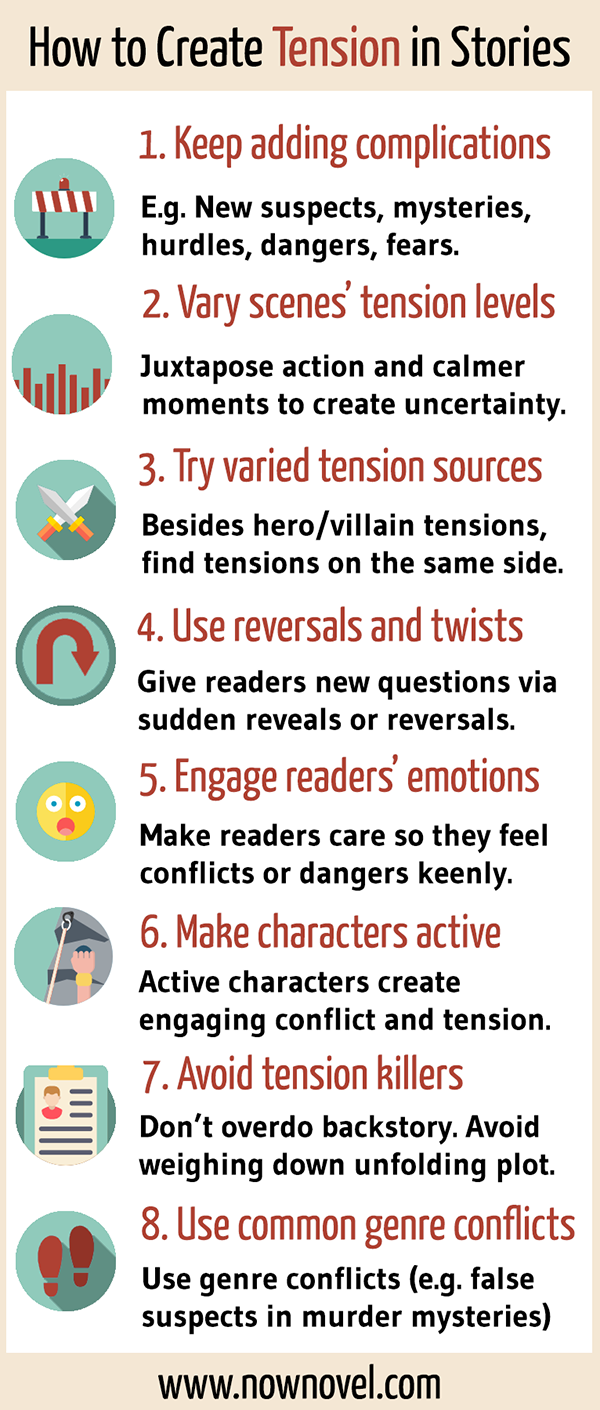
3. Draw story tension from varied places
When we think about creating tension in storytelling, we generally think in terms of protagonists and antagonists; heroes and villains. But remember to create moments of tension between characters who otherwise get along, as well as internal tension.
For example, in a romance novel, in addition to the conflicts that keep the protagonist apart from their love interest, they might have additional conflicts with their sister or best friend. Perhaps your character is moody or glum about their lover’s distance or silence and snaps at others. Secondary, lesser or passing tensions help to keep subplots as interesting as main story and character arcs.
Character-driven TV thrillers offer many examples of effective tension building. In Showtime’s political thriller series Homeland, the main character, Carrie, chooses to go abroad on dangerous CIA assignments. This is partially due to her committed, emotional investment in her work. Yet she also does so to avoid her fear of being an unfit parent to her child, as she struggles with her mental health. This creates a sense of there being unresolved internal conflicts in her life that leave viewers staying on for resolution. The story’s tension is strong, even when it’s a solo scene, for this reason.
4. Use reversals, twists and revelations effectively
These are all excellent ways to heighten tension in a novel.
Some incidents may be two or all three of these things at the same time. For example, the moment that Luke Skywalker learns the infamous, shocking truth about Darth Vader, the main villain in George Lucas’s Star Wars, is both a twist and a revelation. We don’t see this coming although it has been set up from the start in a number of ways.
A famous reversal from classic cinema comes near the end of Casablanca when Ilsa learns Rick is not coming with her. A well-timed plot twist may plunge your characters into uncertainties that we as readers (or viewers) experience as tense suspense.
5. Appeal to readers’ emotions
One important point to keep in mind regarding tension is that it is not the size of the stakes but how invested the reader is in those stakes that matters. When deciding how to create tension in your plot, include emotion. Well-developed characters are critical for readers to become emotionally invested. Most passionate readers know the feeling of finishing a good book and feeling bereft without characters who came to feel like friends. Developing believable and engaging characters who are invested in their goals may seem unrelated to the task of building tension, but it is actually one of the most essential elements for creating this effect.
How else can you create tension in your writing?
6. Increase tension in your writing by making characters active
Active characters make things happen. They react, but they are also proactive. Passive characters let things happen to them. Passive characters are usually not the protagonist (except in tragedies), and they rarely create tension through outward action. Internal conflicts are usually the primary source of tension where these fictional characters are concerned.
Readers tend to like active characters better than passive characters. It’s hard to have much sympathy for characters who simply sit and wait for fate to overtake them.
When active characters keep trying to solve their problems and keep taking missteps, story tension mounts. In a historical romance where two characters are separated by a work assignment, a war or another force, they might write letters, for example. They actively try to overcome the obstacle.
Scenarios like these introduce more opportunities for mishaps and tension. You could, for example, have an entire chapter telling the story of a love letter’s progress as it’s misplaced, wrongfully delivered, returned to sender, and finally reaches its destination. Here, the tension is still between two characters but is shifted onto their communication itself and whether or not it reaches its target.
7. Avoid tension destroyers
There are a few things you should not do or only do sparingly in order to maintain tension:
- Don’t overdo backstory. Your characters had lives before the story started, and sometimes it is necessary to explain your character’s psychology and even to build tension by informing your readers of some of that history. However, too much backstory may drag your novel to a halt
- Don’t tell the reader everything. Tighten your writing. You might have noticed that people in movies and TV shows rarely say goodbye; they just hang up the phone. Of course, you wouldn’t do this in real life, but in a movie, it cuts any fat from the scene. Books are no different. Your reader doesn’t need to have every line of dialogue two characters speak or to know how someone got from one place to another. Stick to key information
- Don’t waste time idling. The tension might be building quickly or very slowly, but the story should always be moving forward in some way, eliciting questions of ‘what next?’ Whenever you write a scene, ask yourself ‘what key piece of the whole does this contribute?’
8. Ground your tension in conflicts that make sense for your genre
All novels need tension, but different types of stories produce tension from different sources.
The main tension in a romance novel will come from whether or not the protagonist and the love interest get together, or struggles they face with each other or facing external events. The main tension in a crime novel involves solving the mystery or catching a criminal. In a similar way to the tip about steadily raising the stakes, this may seem like an obvious observation. Yet often a novel that falls flat has forgotten to focus on what should be the main source of tension, the most urgent unknown.
Once you’ve made certain that you have chosen an effective main source of tension, you can also look to other genre elements to create secondary tension. Your detective in a mystery novel might also be struggling with a romantic relationship. Characters fighting to save their home in a family saga might deal with a murder. Just be sure that you don’t let secondary sources of tension seem like they usurp and detract from the main conflicts of your story.
Structuring your story well is vital if you want to create masterful tension. Try the structured Now Novel process to create a novel outline and stay focused on key, tension-building events.
Source cover image by Leio McLaren
From https://writinggeeks.in/blog/ways-to-increase-your-storys-tension/:
Ways To Increase Your Story’s Tension

Ways To Increase Your Story’s Tension
Ways To Increase Your Story’s Tension
Tension is a beautiful thing in fiction. It’s so subtle that readers (and often writers!) don’t realize its presence on the page, but trust me, it’s pull is powerful. It’s the stuff of page-turners, what keeps readers on the edge of their seats and up until 2am. It’s one of the greatest tools you can wield as a writer.
What is Tension?
Tension is the anticipation of what will happen next in a story. It’s driven by the reader’s concern for the characters and/or their curiosity to know the outcome of a conflict. “Conflict” is the clash between two opposing sides. Conflict is the foundation of your story, and tension comes from conflict.
For example, in Suzanne Collin’s The Hunger Games, the conflict is Katniss taking Prim’s place to fight in the games. She doesn’t want to fight, but the rules of her society leave her with no choice. The tension comes from the reader’s anticipation of whether or not she will survive the games.
Why is Tension Important to Story?
Tension is that “secret ingredient” that keeps readers turning pages. And that’s exactly what you want–for your reader to finish your book (and buy the next one!). A story without tension is lifeless. It drags and bores readers and is in danger of being set aside.
A lot of readers fear people reading their story, but you know what’s worse, what you should really be afraid of? Writing a story that doesn’t get read. But I’m going to help you avoid that dreaded scenario. Let’s dig into some strategies for creating tension that will help carry your readers from page one all the way to The End.
1. Tell Your Characters “No”
Don’t give your characters what they want. It may seem mean, but as an author you have to be mean to your characters. It’s tempting to treat them nice and grant them their every desire like a spoiled child, but if you give in you’ll end up with a dull story.
Does your hero want the girl? To study at a prestigious college? To avenge his friend’s murder? To buy his own boat so he can sail the world? Find out what your hero wants, what his goal is, and then do everything in your power to keep him from getting it!
2. “What’s the Worst Thing That Could Happen?”
If you haven’t already begun to figure it out from the above, as an author, your job is to make your characters’ lives miserable. Whatever situation you put them in, ask yourself what you can do to make it worse.
Let’s say Tom is on his way to his first date with the cute girl he just asked out. But on the way there his car gets a flat. He tries to call for help, but he realizes he forgot his phone at home. He starts to walk, but then it begins to rain and his new suit gets soaked. He flags down a passing car and the driver offers him a lift. But not long after, flashing blue lights appear behind them and the driver leads the police on a high-speed chase. Turns out the driver is a criminal, and when the cops catch up Tom is arrested by association. Needless to say, Tom is having a very bad day.
Getting the idea? This won’t be much fun for your character, but it’s fun for your reader! No one wants to read about how Tom went on a date and everything went fantastic. Yawn. Keep asking: How can I get my hero into trouble? How can I make this problem worse? How can I keep him from getting what he wants?
3. Create Flawed Worlds
Building flaws into your story’s world is a great way to create conflict and tension. The world in which we live isn’t perfect, and this should be reflected in your story.
For example, in The Hunger Games the whole idea of a televised fight to the death between teens is twisted and wrong. In the Mortal Instruments series, Cassandra Clare creates tension by making the Shadowhunters and Downworlders at odds with one another. In Marissa Meyer’s Lunar Chronicles, cyborgs are outcasts and viewed as less than human in their society.
Know the issues of your story’s world. Not only does this give your world more depth and make it feel more realistic, but it presents you with more opportunities for conflict, which you can use to your advantage to create tension.
4. Agree to Disagree
You know what can make a story boring fast? When all of the characters are getting along. Everyone likes one another, and no one argues or disagrees. This is a danger-zone for your story!
You must throw an apple of discord among your characters.
Yes, in real life we want to avoid conflict and we want everyone to like us. But this makes for boring fiction. Characters are always more interesting when they’re not getting along. Let your characters dislike each other. Let them argue about how to solve the problem at hand. Let them disagree and have different opinions. Your reader will thank you for it!
5. Raise the Stakes
One of the best ways to increase the tension in your story is to raise the stakes. “Stakes” are the reward or consequence of your hero achieving or failing his goal.
For example, in The Hunger Games, the stakes for Katniss winning or losing the games is her life. Later in the book, the stakes are raised when it’s announced the Game Makers will allow two winners. Katniss’ reward for success has been increased because she now has the chance to save Peeta. She now has more to lose than just her own life.
Another example is in Cassandra Clare’s City of Bones. The villain, Valentine captured Clary’s mother in the beginning of the book, and towards the climax he also captures Clary’s love interest, Jace. The stakes are raised because if Clary can’t find Valentine not only will she lose her mother, but she’ll also lose the boy she’s beginning to fall in love with.
When you raise the stakes of your story, you instantly increase the reader’s anticipation of finding out what will happen next.
Of course, there are many other ways to create tension in your story than the few listed above. Be on the lookout for ways to create tension at every turn in your story! Put these techniques into practice and you’ll be well on your way to creating a thrilling ride for your reader.
From https://www.standoutbooks.com/10-facts-tell-how-use-tension-your-story/:
10 Facts That Tell You How To Use Tension In Your Story
Tension proves just how engaged readers can be with literature. To take words on a page and translate them into that urgent, nail-biting worry requires great writing and a true emotional engagement from the reader.
Tense scenes leave the reader both desperate to turn the page and afraid to. Tension is the most immediate form of reader engagement and one of the most visceral.
But how do you create tension? How do you build it once you have it? How can you use it effectively in a story without life and death stakes? And more important than any of that: what is tension, really?
1. Tension is stored energy
In physics, tension relies on stored energy. A tensed material is undergoing constant force, and that force has to come from somewhere.
The same is true of a tensely written scene: tension is only established through the intense influence of an outside force. A section of writing can be happy or sad on its own, but it can only be tense when it references something beyond the immediate scene.
Tension isn’t an experience of the moment, it’s a partial experience of the moment with a constant focusing of attention on what comes next. Tension depends on the idea of events beyond the section in which the reader actually feels tense.
The constant force that keeps events tense is the reader’s constant awareness of what comes next.
2. Tension isn’t about the event
One popular theory is that tension is created by dread of an event. For example a scene in which a detective sneaks around a house is tense because the reader is constantly aware that he may be caught.
This seems like a reasonable theory until you look at it a bit closer. If we spend tense scenes dreading an expected event then how come…
3. Any event can inspire tension
In Philip Ardagh’s The Fall of Fergal the story’s tension hinges on a young girl winning a spelling bee. The reader isn’t led to believe that any huge events hinge on the result, yet it’s made clear in the novel that she is deserving of, and in need of, the acknowledgement a win would bring.
The reader may spend tense passages dreading a specific event, but if that can be any event there must be another influence at work.
4. Tension is about consequence
Or to be precise: tension is about the presumed emotional impact of possible consequences. The reader may dread a certain event but only because they’re looking ahead to the consequences of that event and sampling the emotional impact it will have.Tension is about the presumed emotional impact of possible consequences.
Holding the protagonist at gun point is tense because the reader can imagine how they’ll feel if the gun is fired. Tension is simply this expectation stretched out over more than one moment.
5. Imagined consequence can work even better
Paul Auster’s New York trilogy is one of the tensest reads out there, and yet the reader doesn’t know exactly what to dread from one moment to the next.
The protagonists are never threatened with death, just with an escalating sense of the uncanny. Auster cleverly makes it clear that some form of abstract ‘consequences’ are approaching, leaving the reader to invent their own worst case scenario.
Here we see tension at its most basic level. The reader doesn’t even need to know what the consequences will be, or even what event will cause them, they just need to be convinced that they’re worth dreading.
6. Tension is heightened through character
Of course consequences are most powerful when we really care about who has to deal with them. The key to increasing tension isn’t to increase the severity of the event but to increase the reader’s caring and understanding for the characters involved.
The most mundane event can inspire more tension than a life and death exchange if the reader cares enough about the characters.
Fall of Fergal’s spelling bee is tenser than many detective stories ever manage because the reader knows the protagonist’s home life and aspirations. They care deeply about the character’s emotions and so the emotional expectation of her sadness if she loses is palpable.The most mundane event can inspire more tension than a life and death exchange.
7. Tension can be shared with characters…
The reader isn’t the only one who can fear foreseeable consequences. It’s a social impulse that fear increases if we’re around other people who are expressing their fear of it, and when a reader is involved with the story fictional characters can count as people.
Having characters feel tense or scared heightens the reader’s emotional expectation of what could happen and can even be used to steer them. When the character’s dread of possible consequences mixes with the reader’s the character can start suggesting things for the reader to worry about.
8. …Or not
Of course the impulse to worry on someone’s behalf is also powerful. When doom, or mild but potent discomfort, is bearing down on an unsuspecting character the tension can be almost breathtaking.
Why? Because the reader is the only one thinking ahead to the consequences, and that can make the prevention of those consequences feel like their responsibility. Of course unless you’re writing a ‘choose your own adventure’ book there’s nothing the reader can do, but that won’t stop the nail biting tension taking hold.
9. Tension must be sustained
As I said in the first point, tension only occurs when pressure is being exerted. You can’t mention a prowling murderer in chapter one and then expect the reader to remain tense all the way to chapter thirty where he appears again.
There are many ways to do it but you have to work to keep the reader feeling tense. This can be as minor as forcing the reader’s mind back to what could happen if the dreaded event comes to pass.
Fall of Fergal seldom mentions the spelling bee but is littered with examples of the deprivations and poverty the protagonists live with. When the heroine is forced to smuggle her entire family into her room because they can’t afford a second, the author is subtly reminding the reader how little she has in her life and inviting them to ponder how upsetting it would be if she lost.
10. Tension must be resolved satisfactorily
Stretch a rubber band until the rubber is taut, then let go. The rubber resolves the tension by snapping back to its original shape: the energy has to have somewhere to go.
Emotional energy is just the same, except that if you don’t provide the reader with an appropriate outlet, all the tension you’ve built will snap back as irritation.
This is why horror movies set up tense moments and then puncture them with a no-consequences jump scare: the open door and creepy footsteps turn out to be a friend.
Tension needs to be released not just negated. It can release when the dreaded event takes place, the expected emotional reaction converting to an actual emotional reaction, but what if the protagonist wins out?
A moment of relief is a satisfactory release for tension, but it’s not something the reader can feel on their own. As the writer you have to prompt it. This is easier when the reader shares their experience of tension with a character as they can share a moment of relief, but if the reader was the only one who knew a threat was coming you have to give them their own moment.
It doesn’t have to take long, in fact a sentence acknowledging that the sense of threat has passed will usually do. Just don’t carry on as if the tension never existed in the first place.
Tension is a great tool, made all the more enjoyable because it uses the reader’s intellect and awareness to further their emotional enjoyment. The more imaginative and informed a reader is the more implicitly they understand the potential consequences which are being used to create tension.10 Facts That Tell You How To Use Tension In Your Story
Trust your reader, encourage their involvement and understanding, and work with them to make the tension in your story the good kind of unbearable.
Tension works especially well in crime fiction, so if that’s your genre why not try our article How to write a crime novel worth reading? Or for advice on creating tension through pace try 5 popular misconceptions about story pacing.

 KC Storytellers