Jump to section:
The House of Mapuhi by Jack London
DW Article on Themes in The House of Mapuhi
2 Compelling Ways to Weave Themes into Short Stories
5 Ways to Use Theme to Create Character Arc (and Vice Versa)
How to develop story themes: 5 theme examples
25 Things Writers Should Know About Theme
From http://www.online-literature.com/london/65/:
The House of Mapuhi
Despite the heavy clumsiness of her lines, the Aorai handled easily in the light breeze, and her captain ran her well in before he hove to just outside the suck of the surf. The atoll of Hikueru lay low on the water, a circle of pounded coral sand a hundred yards wide, twenty miles in circumference, and from three to five feet above high-water mark. On the bottom of the huge and glassy lagoon was much pearl shell, and from the deck of the schooner, across the slender ring of the atoll, the divers could be seen at work. But the lagoon had no entrance for even a trading schooner. With a favoring breeze cutters could win in through the tortuous and shallow channel, but the schooners lay off and on outside and sent in their small boats.
The Aorai swung out a boat smartly, into which sprang half a dozen brown-skinned sailors clad only in scarlet loincloths. They took the oars, while in the stern sheets, at the steering sweep, stood a young man garbed in the tropic white that marks the European. The golden strain of Polynesia betrayed itself in the sun-gilt of his fair skin and cast up golden sheens and lights through the glimmering blue of his eyes. Raoul he was, Alexandre Raoul, youngest son of Marie Raoul, the wealthy quarter-caste, who owned and managed half a dozen trading schooners similar to the Aorai. Across an eddy just outside the entrance, and in and through and over a boiling tide-rip, the boat fought its way to the mirrored calm of the lagoon. Young Raoul leaped out upon the white sand and shook hands with a tall native. The man’s chest and shoulders were magnificent, but the stump of a right arm, beyond the flesh of which the age-whitened bone projected several inches, attested the encounter with a shark that had put an end to his diving days and made him a fawner and an intriguer for small favors.
“Have you heard, Alec?” were his first words. “Mapuhi has found a pearl–such a pearl. Never was there one like it ever fished up in Hikueru, nor in all the Paumotus, nor in all the world. Buy it from him. He has it now. And remember that I told you first. He is a fool and you can get it cheap. Have you any tobacco?”
Straight up the beach to a shack under a pandanus tree Raoul headed. He was his mother’s supercargo, and his business was to comb all the Paumotus for the wealth of copra, shell, and pearls that they yielded up.
He was a young supercargo, it was his second voyage in such capacity, and he suffered much secret worry from his lack of experience in pricing pearls. But when Mapuhi exposed the pearl to his sight he managed to suppress the startle it gave him, and to maintain a careless, commercial expression on his face. For the pearl had struck him a blow. It was large as a pigeon egg, a perfect sphere, of a whiteness that reflected opalescent lights from all colors about it. It was alive. Never had he seen anything like it. When Mapuhi dropped it into his hand he was surprised by the weight of it. That showed that it was a good pearl. He examined it closely, through a pocket magnifying glass. It was without flaw or blemish. The purity of it seemed almost to melt into the atmosphere out of his hand. In the shade it was softly luminous, gleaming like a tender moon. So translucently white was it, that when he dropped it into a glass of water he had difficulty in finding it. So straight and swiftly had it sunk to the bottom that he knew its weight was excellent.
“Well, what do you want for it?” he asked, with a fine assumption of nonchalance.
“I want–” Mapuhi began, and behind him, framing his own dark face, the dark faces of two women and a girl nodded concurrence in what he wanted. Their heads were bent forward, they were animated by a suppressed eagerness, their eyes flashed avariciously.
“I want a house,” Mapuhi went on. “It must have a roof of galvanized iron and an octagon-drop-clock. It must be six fathoms long with a porch all around. A big room must be in the centre, with a round table in the middle of it and the octagon-drop-clock on the wall. There must be four bedrooms, two on each side of the big room, and in each bedroom must be an iron bed, two chairs, and a washstand. And back of the house must be a kitchen, a good kitchen, with pots and pans and a stove. And you must build the house on my island, which is Fakarava.”
“Is that all?” Raoul asked incredulously.
“There must be a sewing machine,” spoke up Tefara, Mapuhi’s wife.
“Not forgetting the octagon-drop-clock,” added Nauri, Mapuhi’s mother.
“Yes, that is all,” said Mapuhi.
Young Raoul laughed. He laughed long and heartily. But while he laughed he secretly performed problems in mental arithmetic. He had never built a house in his life, and his notions concerning house building were hazy. While he laughed, he calculated the cost of the voyage to Tahiti for materials, of the materials themselves, of the voyage back again to Fakarava, and the cost of landing the materials and of building the house. It would come to four thousand French dollars, allowing a margin for safety–four thousand French dollars were equivalent to twenty thousad francs. It was impossible. How was he to know the value of such a pearl? Twenty thousand francs was a lot of money–and of his mother’s money at that.
“Mapuhi,” he said, “you are a big fool. Set a money price.”
But Mapuhi shook his head, and the three heads behind him shook with his.
“I want the house,” he said. “It must be six fathoms long with a porch all around–“
“Yes, yes,” Raoul interrupted. “I know all about your house, but it won’t do. I’ll give you a thousand Chili dollars.”
The four heads chorused a silent negative.
“And a hundred Chili dollars in trade.”
“I want the house,” Mapuhi began.
“What good will the house do you?” Raoul demanded. “The first hurricane that comes along will wash it away. You ought to know.
Captain Raffy says it looks like a hurricane right now.”
“Not on Fakarava,” said Mapuhi. “The land is much higher there. On this island, yes. Any hurricane can sweep Hikueru. I will have the house on Fakarava. It must be six fathoms long with a porch all around–“
And Raoul listened again to the tale of the house. Several hours he spent in the endeavor to hammer the house obsession out of Mapuhi’s mind; but Mapuhi’s mother and wife, and Ngakura, Mapuhi’s daughter, bolstered him in his resolve for the house. Through the open doorway, while he listened for the twentieth time to the detailed description of the house that was wanted, Raoul saw his schooner’s second boat draw up on the beach. The sailors rested on the oars, advertising haste to be gone. The first mate of the Aorai sprang ashore, exchanged a word with the one-armed native, then hurried toward Raoul. The day grew suddenly dark, as a squall obscured the face of the sun. Across the lagoon Raoul could see approaching the ominous line of the puff of wind.
“Captain Raffy says you’ve got to get to hell outa here,” was the mate’s greeting. “If there’s any shell, we’ve got to run the risk of picking it up later on–so he says. The barometer’s dropped to twenty-nine-seventy.”
The gust of wind struck the pandanus tree overhead and tore through the palms beyond, flinging half a dozen ripe cocoanuts with heavy thuds to the ground. Then came the rain out of the distance, advancing with the roar of a gale of wind and causing the water of the lagoon to smoke in driven windrows. The sharp rattle of the first drops was on the leaves when Raoul sprang to his feet.
“A thousand Chili dollars, cash down, Mapuhi,” he said. “And two hundred Chili dollars in trade.”
“I want a house–” the other began.
“Mapuhi!” Raoul yelled, in order to make himself heard. “You are a fool!”
He flung out of the house, and, side by side with the mate, fought his way down the beach toward the boat. They could not see the boat. The tropic rain sheeted about them so that they could see only the beach under their feet and the spiteful little waves from the lagoon that snapped and bit at the sand. A figure appeared through the deluge. It was Huru-Huru, the man with the one arm.
“Did you get the pearl?” he yelled in Raoul’s ear.
“Mapuhi is a fool!” was the answering yell, and the next moment they were lost to each other in the descending water.
Half an hour later, Huru-Huru, watching from the seaward side of the atoll, saw the two boats hoisted in and the Aorai pointing her nose out to sea. And near her, just come in from the sea on the wings of the squall, he saw another schooner hove to and dropping a boat into the water. He knew her. It was the OROHENA, owned by Toriki, the half-caste trader, who served as his own supercargo and who doubtlessly was even then in the stern sheets of the boat. Huru-Huru chuckled. He knew that Mapuhi owed Toriki for trade goods advanced the year before.
The squall had passed. The hot sun was blazing down, and the lagoon was once more a mirror. But the air was sticky like mucilage, and the weight of it seemed to burden the lungs and make breathing difficult.
“Have you heard the news, Toriki?” Huru-Huru asked. “Mapuhi has found a pearl. Never was there a pearl like it ever fished up in Hikueru, nor anywhere in the Paumotus, nor anywhere in all the world. Mapuhi is a fool. Besides, he owes you money. Remember that I told you first. Have you any tobacco?”
And to the grass shack of Mapuhi went Toriki. He was a masterful man, withal a fairly stupid one. Carelessly he glanced at the wonderful pearl–glanced for a moment only; and carelessly he dropped it into his pocket.
“You are lucky,” he said. “It is a nice pearl. I will give you credit on the books.”
“I want a house,” Mapuhi began, in consternation. “It must be six fathoms–“
“Six fathoms your grandmother!” was the trader’s retort. “You want to pay up your debts, that’s what you want. You owed me twelve hundred dollars Chili. Very well; you owe them no longer. The amount is squared. Besides, I will give you credit for two hundred Chili. If, when I get to Tahiti, the pearl sells well, I will give you credit for another hundred–that will make three hundred. But mind, only if the pearl sells well. I may even lose money on it.”
Mapuhi folded his arms in sorrow and sat with bowed head. He had been robbed of his pearl. In place of the house, he had paid a debt. There was nothing to show for the pearl.
“You are a fool,” said Tefara.
“You are a fool,” said Nauri, his mother. “Why did you let the pearl into his hand?”
“What was I to do?” Mapuhi protested. “I owed him the money. He knew I had the pearl. You heard him yourself ask to see it. I had not told him. He knew. Somebody else told him. And I owed him the money.”
“Mapuhi is a fool,” mimicked Ngakura.
She was twelve years old and did not know any better. Mapuhi relieved his feelings by sending her reeling from a box on the ear; while Tefara and Nauri burst into tears and continued to upbraid him after the manner of women.
Huru-Huru, watching on the beach, saw a third schooner that he knew heave to outside the entrance and drop a boat. It was the Hira, well named, for she was owned by Levy, the German Jew, the greatest pearl buyer of them all, and, as was well known, Hira was the Tahitian god of fishermen and thieves.
“Have you heard the news?” Huru-Huru asked, as Levy, a fat man with massive asymmetrical features, stepped out upon the beach. “Mapuhi has found a pearl. There was never a pearl like it in Hikueru, in all the Paumotus, in all the world. Mapuhi is a fool. He has sold it to Toriki for fourteen hundred Chili–I listened outside and heard. Toriki is likewise a fool. You can buy it from him cheap. Remember that I told you first. Have you any tobacco?”
“Where is Toriki?”
“In the house of Captain Lynch, drinking absinthe. He has been there an hour.”
And while Levy and Toriki drank absinthe and chaffered over the pearl, Huru-Huru listened and heard the stupendous price of twenty-five thousand francs agreed upon.
It was at this time that both the OROHENA and the Hira, running in close to the shore, began firing guns and signalling frantically. The three men stepped outside in time to see the two schooners go hastily about and head off shore, dropping mainsails and flying jibs on the run in the teeth of the squall that heeled them far over on the whitened water. Then the rain blotted them out.
“They’ll be back after it’s over,” said Toriki. “We’d better be getting out of here.”
“I reckon the glass has fallen some more,” said Captain Lynch.
He was a white-bearded sea-captain, too old for service, who had learned that the only way to live on comfortable terms with his asthma was on Hikueru. He went inside to look at the barometer.
“Great God!” they heard him exclaim, and rushed in to join him at staring at a dial, which marked twenty-nine-twenty.
Again they came out, this time anxiously to consult sea and sky. The squall had cleared away, but the sky remained overcast. The two schooners, under all sail and joined by a third, could be seen making back. A veer in the wind induced them to slack off sheets, and five minutes afterward a sudden veer from the opposite quarter caught all three schooners aback, and those on shore could see the boom-tackles being slacked away or cast off on the jump. The sound of the surf was loud, hollow, and menacing, and a heavy swell was setting in. A terrible sheet of lightning burst before their eyes, illuminating the dark day, and the thunder rolled wildly about them.
Toriki and Levy broke into a run for their boats, the latter ambling along like a panic-stricken hippopotamus. As their two boats swept out the entrance, they passed the boat of the Aorai coming in. In the stern sheets, encouraging the rowers, was Raoul. Unable to shake the vision of the pearl from his mind, he was returning to accept Mapuhi’s price of a house.
He landed on the beach in the midst of a driving thunder squall that was so dense that he collided with Huru-Huru before he saw him.
“Too late,” yelled Huru-Huru. “Mapuhi sold it to Toriki for fourteen hundred Chili, and Toriki sold it to Levy for twenty-five thousand francs. And Levy will sell it in France for a hundred thousand francs. Have you any tobacco?”
Raoul felt relieved. His troubles about the pearl were over. He need not worry any more, even if he had not got the pearl. But he did not believe Huru-Huru. Mapuhi might well have sold it for fourteen hundred Chili, but that Levy, who knew pearls, should have paid twenty-five thousand francs was too wide a stretch. Raoul decided to interview Captain Lynch on the subject, but when he arrived at that ancient mariner’s house, he found him looking wide-eyed at the barometer.
“What do you read it?” Captain Lynch asked anxiously, rubbing his spectables and staring again at the instrument.
“Twenty-nine-ten,” said Raoul. “I have never seen it so low before.”
“I should say not!” snorted the captain. “Fifty years boy and man on all the seas, and I’ve never seen it go down to that. Listen!”
They stood for a moment, while the surf rumbled and shook the house. Then they went outside. The squall had passed. They could see the Aorai lying becalmed a mile away and pitching and tossing madly in the tremendous seas that rolled in stately procession down out of the northeast and flung themselves furiously upon the coral shore. One of the sailors from the boat pointed at the mouth of the passage and shook his head. Raoul looked and saw a white anarchy of foam and surge.
“I guess I’ll stay with you tonight, Captain,” he said; then turned to the sailor and told him to haul the boat out and to find shelter for himself and fellows.
“Twenty-nine flat,” Captain Lynch reported, coming out from another look at the barometer, a chair in his hand.
He sat down and stared at the spectacle of the sea. The sun came out, increasing the sultriness of the day, while the dead calm still held. The seas continued to increase in magnitude.
“What makes that sea is what gets me,” Raoul muttered petulantly.
“There is no wind, yet look at it, look at that fellow there!”
Miles in length, carrying tens of thousands of tons in weight, its impact shook the frail atoll like an earthquake. Captain Lynch was startled.
“Gracious!” he bellowed, half rising from his chair, then sinking back.
“But there is no wind,” Raoul persisted. “I could understand it if there was wind along with it.”
“You’ll get the wind soon enough without worryin’ for it,” was the grim reply.
The two men sat on in silence. The sweat stood out on their skin in myriads of tiny drops that ran together, forming blotches of moisture, which, in turn, coalesced into rivulets that dripped to the ground. They panted for breath, the old man’s efforts being especially painful. A sea swept up the beach, licking around the trunks of the cocoanuts and subsiding almost at their feet.
“Way past high water mark,” Captain Lynch remarked; “and I’ve been here eleven years.” He looked at his watch. “It is three o’clock.”
A man and woman, at their heels a motley following of brats and curs, trailed disconsolately by. They came to a halt beyond the house, and, after much irresolution, sat down in the sand. A few minutes later another family trailed in from the opposite direction, the men and women carrying a heterogeneous assortment of possessions. And soon several hundred persons of all ages and sexes were congregated about the captain’s dwelling. He called to one new arrival, a woman with a nursing babe in her arms, and in answer received the information that her house had just been swept into the lagoon.
This was the highest spot of land in miles, and already, in many places on either hand, the great seas were making a clean breach of the slender ring of the atoll and surging into the lagoon. Twenty miles around stretched the ring of the atoll, and in no place was it more than fifty fathoms wide. It was the height of the diving season, and from all the islands around, even as far as Tahiti, the natives had gathered.
“There are twelve hundred men, women, and children here,” said Captain Lynch. “I wonder how many will be here tomorrow morning.”
“But why don’t it blow?–that’s what I want to know,” Raoul demanded.
“Don’t worry, young man, don’t worry; you’ll get your troubles fast enough.”
Even as Captain Lynch spoke, a great watery mass smote the atoll.
The sea water churned about them three inches deep under the chairs. A low wail of fear went up from the many women. The children, with clasped hands, stared at the immense rollers and cried piteously. Chickens and cats, wading perturbedly in the water, as by common consent, with flight and scramble took refuge on the roof of the captain’s house. A Paumotan, with a litter of new-born puppies in a basket, climbed into a cocoanut tree and twenty feet above the ground made the basket fast. The mother floundered about in the water beneath, whining and yelping.
And still the sun shone brightly and the dead calm continued. They sat and watched the seas and the insane pitching of the Aorai. Captain Lynch gazed at the huge mountains of water sweeping in until he could gaze no more. He covered his face with his hands to shut out the sight; then went into the house.
“Twenty-eight-sixty,” he said quietly when he returned.
In his arm was a coil of small rope. He cut it into two-fathom lengths, giving one to Raoul and, retaining one for himself, distributed the remainder among the women with the advice to pick out a tree and climb.
A light air began to blow out of the northeast, and the fan of it on his cheek seemed to cheer Raoul up. He could see the Aorai trimming her sheets and heading off shore, and he regretted that he was not on her. She would get away at any rate, but as for the atoll–A sea breached across, almost sweeping him off his feet, and he selected a tree. Then he remembered the barometer and ran back to the house. He encountered Captain Lynch on the same errand and together they went in.
“Twenty-eight-twenty,” said the old mariner. “It’s going to be fair hell around here–what was that?”
The air seemed filled with the rush of something. The house quivered and vibrated, and they heard the thrumming of a mighty note of sound. The windows rattled. Two panes crashed; a draught of wind tore in, striking them and making them stagger. The door opposite banged shut, shattering the latch. The white door knob crumbled in fragments to the floor. The room’s walls bulged like a gas balloon in the process of sudden inflation. Then came a new sound like the rattle of musketry, as the spray from a sea struck the wall of the house. Captain Lyncyh looked at his watch. It was four o’clock. He put on a coat of pilot cloth, unhooked the barometer, and stowed it away in a capacious pocket. Again a sea struck the house, with a heavy thud, and the light building tilted, twisted, quarter around on its foundation, and sank down, its floor at an angle of ten degrees.
Raoul went out first. The wind caught him and whirled him away. He noted that it had hauled around to the east. With a great effort he threw himself on the sand, crouching and holding his own. Captain Lynch, driven like a wisp of straw, sprawled over him. Two of the Aorai’S sailors, leaving a cocoanut tree to which they had been clinging, came to their aid, leaning against the wind at impossible angles and fighting and clawing every inch of the way.
The old man’s joints were stiff and he could not climb, so the sailors, by means of short ends of rope tied together, hoisted him up the trunk, a few feet at a time, till they could make him fast, at the top of the tree, fifty feet from the ground. Raoul passed his length of rope around the base of an adjacent tree and stood looking on. The wind was frightful. He had never dreamed it could blow so hard. A sea breached across the atoll, wetting him to the knees ere it subsided into the lagoon. The sun had disappeared, and a lead-colored twilight settled down. A few drops of rain, driving horizontally, struck him. The impact was like that of leaden pellets. A splash of salt spray struck his face. It was like the slap of a man’s hand. His cheeks stung, and involuntary tears of pain were in his smarting eyes. Several hundred natives had taken to the trees, and he could have laughed at the bunches of human fruit clustering in the tops. Then, being Tahitian-born, he doubled his body at the waist, clasped the trunk of his tree with his hands, pressed the soles of his feet against the near surface of the trunk, and began to walk up the tree. At the top he found two women, two children, and a man. One little girl clasped a housecat in her arms.
From his eyrie he waved his hand to Captain Lynch, and that doughty patriarch waved back. Raoul was appalled at the sky. It had approached much nearer–in fact, it seemed just over his head; and it had turned from lead to black. Many people were still on the ground grouped about the bases of the trees and holding on. Several such clusters were praying, and in one the Mormon missionary was exhorting. A weird sound, rhythmical, faint as the faintest chirp of a far cricket, enduring but for a moment, but in the moment suggesting to him vaguely the thought of heaven and celestial music, came to his ear. He glanced about him and saw, at the base of another tree, a large cluster of people holding on by ropes and by one another. He could see their faces working and their lips moving in unison. No sound came to him, but he knew that they were singing hymns.
Still the wind continued to blow harder. By no conscious process could he measure it, for it had long since passed beyond all his experience of wind; but he knew somehow, nevertheless, that it was blowing harder. Not far away a tree was uprooted, flinging its load of human beings to the ground. A sea washed across the strip of sand, and they were gone. Things were happening quickly. He saw a brown shoulder and a black head silhouetted against the churning white of the lagoon. The next instant that, too, had vanished. Other trees were going, falling and criss-crossing like matches. He was amazed at the power of the wind. His own tree was swaying perilously, one woman was wailing and clutching the little girl, who in turn still hung on to the cat.
The man, holding the other child, touched Raoul’s arm and pointed. He looked and saw the Mormon church careering drunkenly a hundred feet away. It had been torn from its foundations, and wind and sea were heaving and shoving it toward the lagoon. A frightful wall of water caught it, tilted it, and flung it against half a dozen cocoanut trees. The bunches of human fruit fell like ripe cocoanuts. The subsiding wave showed them on the ground, some lying motionless, others squirming and writhing. They reminded him strangely of ants. He was not shocked. He had risen above horror. Quite as a matter of course he noted the succeeding wave sweep the sand clean of the human wreckage. A third wave, more colossal than any he had yet seen, hurled the church into the lagoon, where it floated off into the obscurity to leeward, half-submerged, reminding him for all the world of a Noah’s ark.
He looked for Captain Lynch’s house, and was surprised to find it gone. Things certainly were happening quickly. He noticed that many of the people in the trees that still held had descended to the ground. The wind had yet again increased. His own tree showed that. It no longer swayed or bent over and back. Instead, it remained practically stationary, curved in a rigid angle from the wind and merely vibrating. But the vibration was sickening. It was like that of a tuning-fork or the tongue of a jew’s-harp. It was the rapidity of the vibration that made it so bad. Even though its roots held, it could not stand the strain for long. Something would have to break.
Ah, there was one that had gone. He had not seen it go, but there it stood, the remnant, broken off half-way up the trunk. One did not know what happened unless he saw it. The mere crashing of trees and wails of human despair occupied no place in that mighty volume of sound. He chanced to be looking in Captain Lynch’s direction when it happened. He saw the trunk of the tree, half-way up, splinter and part without noise. The head of the tree, with three sailors of the Aorai and the old captain sailed off over the lagoon. It did not fall to the ground, but drove through the air like a piece of chaff. For a hundred yards he followed its flight, when it struck the water. He strained his eyes, and was sure that he saw Captain Lynch wave farewell.
Raoul did not wait for anything more. He touched the native and made signs to descend to the ground. The man was willing, but his women were paralayzed from terror, and he elected to remain with them. Raoul passed his rope around the tree and slid down. A rush of salt water went over his head. He held his breath and clung desperately to the rope. The water subsided, and in the shelter of the trunk he breathed once more. He fastened the rope more securely, and then was put under by another sea. One of the women slid down and joined him, the native remaining by the other woman, the two children, and the cat.
The supercargo had noticed how the groups clinging at the bases of the other trees continually diminished. Now he saw the process work out alongside him. It required all his strength to hold on, and the woman who had joined him was growing weaker. Each time he emerged from a sea he was surprised to find himself still there, and next, surprised to find the woman still there. At last he emerged to find himself alone. He looked up. The top of the tree had gone as well. At half its original height, a splintered end vibrated. He was safe. The roots still held, while the tree had been shorn of its windage. He began to climb up. He was so weak that he went slowly, and sea after sea caught him before he was above them. Then he tied himself to the trunk and stiffened his soul to face the night and he knew not what.
He felt very lonely in the darkness. At times it seemed to him that it was the end of the world and that he was the last one left alive. Still the wind increased. Hour after hour it increased. By what he calculated was eleven o’clock, the wind had become unbelievable. It was a horrible, monstrous thing, a screaming fury, a wall that smote and passed on but that continued to smite and pass on–a wall without end. It seemed to him that he had become light and ethereal; that it was he that was in motion; that he was being driven with inconceivable velocity through unending solidness. The wind was no longer air in motion. It had become substantial as water or quicksilver. He had a feeling that he could reach into it and tear it out in chunks as one might do with the meat in the carcass of a steer; that he could seize hold of the wind and hang on to it as a man might hang on to the face of a cliff.
The wind strangled him. He could not face it and breathe, for it rushed in through his mouth and nostrils, distending his lungs like bladders. At such moments it seemed to him that his body was being packed and swollen with solid earth. Only by pressing his lips to the trunk of the tree could he breathe. Also, the ceaseless impact of the wind exhausted him. Body and brain became wearied. He no longer observed, no longer thought, and was but semiconscious. One idea constituted his consciousness: SO THIS WAS A HURRICANE. That one idea persisted irregularly. It was like a feeble flame that flickered occasionally. From a state of stupor he would return to it–SO THIS WAS A HURRICANE. Then he would go off into another stupor.
The height of the hurricane endured from eleven at night till three in the morning, and it was at eleven that the tree in which clung Mapuhi and his women snapped off. Mapuhi rose to the surface of the lagoon, still clutching his daughter Ngakura. Only a South Sea islander could have lived in such a driving smother. The pandanus tree, to which he attached himself, turned over and over in the froth and churn; and it was only by holding on at times and waiting, and at other times shifting his grips rapidly, that he was able to get his head and Ngakura’s to the surface at intervals sufficiently near together to keep the breath in them. But the air was mostly water, what with flying spray and sheeted rain that poured along at right angles to the perpendicular.
It was ten miles across the lagoon to the farther ring of sand. Here, tossing tree trunks, timbers, wrecks of cutters, and wreckage of houses, killed nine out of ten of the miserable beings who survived the passage of the lagoon. Half-drowned, exhausted, they were hurled into this mad mortar of the elements and battered into formless flesh. But Mapuhi was fortunate. His chance was the one in ten; it fell to him by the freakage of fate. He emerged upon the sand, bleeding from a score of wounds.
Ngakura’s left arm was broken; the fingers of her right hand were crushed; and cheek and forehead were laid open to the bone. He clutched a tree that yet stood, and clung on, holding the girl and sobbing for air, while the waters of the lagoon washed by knee-high and at times waist-high.
At three in the morning the backbone of the hurricane broke. By five no more than a stiff breeze was blowing. And by six it was dead calm and the sun was shining. The sea had gone down. On the yet restless edge of the lagoon, Mapuhi saw the broken bodies of those that had failed in the landing. Undoubtedly Tefara and Nauri were among them. He went along the beach examining them, and came upon his wife, lying half in and half out of the water. He sat down and wept, making harsh animal noises after the manner of primitive grief. Then she stirred uneasily, and groaned. He looked more closely. Not only was she alive, but she was uninjured. She was merely sleeping. Hers also had been the one chance in ten.
Of the twelve hundred alive the night before but three hundred remained. The mormon missionary and a gendarme made the census. The lagoon was cluttered with corpses. Not a house nor a hut was standing. In the whole atoll not two stones remained one upon another. One in fifty of the cocoanut palms still stood, and they were wrecks, while on not one of them remained a single nut.
There was no fresh water. The shallow wells that caught the surface seepage of the rain were filled with salt. Out of the lagoon a few soaked bags of flour were recovered. The survivors cut the hearts out of the fallen cocoanut trees and ate them. Here and there they crawled into tiny hutches, made by hollowing out the sand and covering over with fragments of metal roofing. The missionary made a crude still, but he could not distill water for three hundred persons. By the end of the second day, Raoul, taking a bath in the lagoon, discovered that his thirst was somewhat relieved. He cried out the news, and thereupon three hundred men, women, and children could have been seen, standing up to their necks in the lagoon and trying to drink water in through their skins. Their dead floated about them, or were stepped upon where they still lay upon the bottom. On the third day the people buried their dead and sat down to wait for the rescue steamers.
In the meantime, Nauri, torn from her family by the hurricane, had been swept away on an adventure of her own. Clinging to a rough plank that wounded and bruised her and that filled her body with splinters, she was thrown clear over the atoll and carried away to sea. Here, under the amazing buffets of mountains of water, she lost her plank. She was an old woman nearly sixty; but she was Paumotan-born, and she had never been out of sight of the sea in her life. Swimming in the darkness, strangling, suffocating, fighting for air, she was struck a heavy blow on the shoulder by a cocoanut. On the instant her plan was formed, and she seized the nut. In the next hour she captured seven more. Tied together, they formed a life-buoy that preserved her life while at the same time it threatened to pound her to a jelly. She was a fat woman, and she bruised easily; but she had had experience of hurricanes, and while she prayed to her shark god for protection from sharks, she waited for the wind to break. But at three o’clock she was in such a stupor that she did not know. Nor did she know at six o’clock when the dead calm settled down. She was shocked into consciousness when she was thrown upon the sand. She dug in with raw and bleeding hands and feet and clawed against the backwash until she was beyond the reach of the waves.
She knew where she was. This land could be no other than the tiny islet of Takokota. It had no lagoon. No one lived upon it.
Hikueru was fifteen miles away. She could not see Hikueru, but she knew that it lay to the south. The days went by, and she lived on the cocoanuts that had kept her afloat. They supplied her with drinking water and with food. But she did not drink all she wanted, nor eat all she wanted. Rescue was problematical. She saw the smoke of the rescue steamers on the horizon, but what steamer could be expected to come to lonely, uninhabited Takokota?
From the first she was tormented by corpses. The sea persisted in flinging them upon her bit of sand, and she persisted, until her strength failed, in thrusting them back into the sea where the sharks tore at them and devoured them. When her strength failed, the bodies festooned her beach with ghastly horror, and she withdrew from them as far as she could, which was not far.
By the tenth day her last cocoanut was gone, and she was shrivelling from thirst. She dragged herself along the sand, looking for cocoanuts. It was strange that so many bodies floated up, and no nuts. Surely, there were more cocoanuts afloat than dead men! She gave up at last, and lay exhausted. The end had come. Nothing remained but to wait for death.
Coming out of a stupor, she became slowly aware that she was gazing at a patch of sandy-red hair on the head of a corpse. The sea flung the body toward her, then drew it back. It turned over, and she saw that it had no face. Yet there was something familiar about that patch of sandy-red hair. An hour passed. She did not exert herself to make the identification. She was waiting to die, and it mattered little to her what man that thing of horror once might have been.
But at the end of the hour she sat up slowly and stared at the corpse. An unusually large wave had thrown it beyond the reach of the lesser waves. Yes, she was right; that patch of red hair could belong to but one man in the Paumotus. It was Levy, the German Jew, the man who had bought the pearl and carried it away on the Hira. Well, one thing was evident: The Hira had been lost. The pearl buyer’s god of fishermen and thieves had gone back on him.
She crawled down to the dead man. His shirt had been torn away, and she could see the leather money belt about his waist. She held her breath and tugged at the buckles. They gave easier than she had expected, and she crawled hurriedly away across the sand, dragging the belt after her. Pocket after pocket she unbuckled in the belt and found empty. Where could he have put it? In the last pocket of all she found it, the first and only pearl he had bought on the voyage. She crawled a few feet farther, to escape the pestilence of the belt, and examined the pearl. It was the one Mapuhi had found and been robbed of by Toriki. She weighed it in her hand and rolled it back and forth caressingly. But in it she saw no intrinsic beauty. What she did see was the house Mapuhi and Tefara and she had builded so carefully in their minds. Each time she looked at the pearl she saw the house in all its details, including the octagon-drop-clock on the wall. That was something to live for.
She tore a strip from her ahu and tied the pearl securely about her neck. Then she went on along the beach, panting and groaning, but resolutely seeking for cocoanuts. Quickly she found one, and, as she glanced around, a second. She broke one, drinking its water, which was mildewy, and eating the last particle of the meat. A little later she found a shattered dugout. Its outrigger was gone, but she was hopeful, and, before the day was out, she found the outrigger. Every find was an augury. The pearl was a talisman. Late in the afternoon she saw a wooden box floating low in the water. When she dragged it out on the beach its contents rattled, and inside she found ten tins of salmon. She opened one by hammering it on the canoe. When a leak was started, she drained the tin. After that she spent several hours in extracting the salmon, hammering and squeezing it out a morsel at a time.
Eight days longer she waited for rescue. In the meantime she fastened the outrigger back on the canoe, using for lashings all the cocoanut fibre she could find, and also what remained of her ahu. The canoe was badly cracked, and she could not make it water-tight; but a calabash made from a cocoanut she stored on board for a bailer. She was hard put for a paddle. With a piece of tin she sawed off all her hair close to the scalp. Out of the hair she braided a cord; and by means of the cord she lashed a three-foot piece of broom handle to a board from the salmon case.
She gnawed wedges with her teeth and with them wedged the lashing.
On the eighteenth day, at midnight, she launched the canoe through the surf and started back for Hikueru. She was an old woman. Hardship had stripped her fat from her till scarcely more than bones and skin and a few stringy muscles remained. The canoe was large and should have been paddled by three strong men.
But she did it alone, with a make-shift paddle. Also, the canoe leaked badly, and one-third of her time was devoted to bailing. By clear daylight she looked vainly for Hikueru. Astern, Takokota had sunk beneath the sea rim. The sun blazed down on her nakedness, compelling her body to surrender its moisture. Two tins of salmon were left, and in the course of the day she battered holes in them and drained the liquid. She had no time to waste in extracting the meat. A current was setting to the westward, she made westing whether she made southing or not.
In the eary afternoon, standing upright in the canoe, she sighted Hikueru. Its wealth of cocoanut palms was gone. Only here and there, at wide intervals, could she see the ragged remnants of trees. The sight cheered her. She was nearer than she had thought. The current was setting her to the westward. She bore up against it and paddled on. The wedges in the paddle lashing worked loose, and she lost much time, at frequent intervals, in driving them tight. Then there was the bailing. One hour in three she had to cease paddling in order to bail. And all the time she driftd to the westward.
By sunset Hikueru bore southeast from her, three miles away. There was a full moon, and by eight o’clock the land was due east and two miles away. She struggled on for another hour, but the land was as far away as ever. She was in the main grip of the current; the canoe was too large; the paddle was too inadequate; and too much of her time and strength was wasted in bailing. Besides, she was very weak and growing weaker. Despite her efforts, the canoe was drifting off to the westward.
She breathed a prayer to her shark god, slipped over the side, and began to swim. She was actually refreshed by the water, and quickly left the canoe astern. At the end of an hour the land was perceptibly nearer. Then came her fright. Right before her eyes, not twenty feet away, a large fin cut the water. She swam steadily toward it, and slowly it glided away, curving off toward the right and circling around her. She kept her eyes on the fin and swam on. When the fin disappeared, she lay face downward in the water and watched. When the fin reappeared she resumed her swimming. The monster was lazy–she could see that. Without doubt he had been well fed since the hurricane. Had he been very hungry, she knew he would not have hesitated from making a dash for her. He was fifteen feet long, and one bite, she knew, could cut her in half.
But she did not have any time to waste on him. Whether she swam or not, the current drew away from the land just the same. A half hour went by, and the shark began to grow bolder. Seeing no harm in her he drew closer, in narrowing circles, cocking his eyes at her impudently as he slid past. Sooner or later, she knew well enough, he would get up sufficient courage to dash at her. She resolved to play first. It was a desperate act she meditated. She was an old woman, alone in the sea and weak from starvation and hardship; and yet she, in the face of this sea tiger, must anticipate his dash by herself dashing at him. She swam on, waiting her chance. At last he passed languidly by, barely eight feet away. She rushed at him suddenly, feigning that she was attacking him. He gave a wild flirt of his tail as he fled away, and his sandpaper hide, striking her, took off her skin from elbow to shoulder. He swam rapidly, in a widening circle, and at last disappeared.
In the hole in the sand, covered over by fragments of metal roofing, Mapuhi and Tefara lay disputing.
“If you had done as I said,” charged Tefara, for the thousandth time, “and hidden the pearl and told no one, you would have it now.”
“But Huru-Huru was with me when I opened the shell–have I not told you so times and times and times without end?”
“And now we shall have no house. Raoul told me today that if you had not sold the pearl to Toriki–“
“I did not sell it. Toriki robbed me.”
“–that if you had not sold the pearl, he would give you five thousand French dollars, which is ten thousand Chili.”
“He has been talking to his mother,” Mapuhi explained. “She has an eye for a pearl.”
“And now the pearl is lost,” Tefara complained.
“It paid my debt with Toriki. That is twelve hundred I have made, anyway.”
“Toriki is dead,” she cried. “They have heard no word of his schooner. She was lost along with the Aorai and the Hira. Will Toriki pay you the three hundred credit he promised? No, because Toriki is dead. And had you found no pearl, would you today owe Toriki the twelve hundred? No, because Toriki is dead, and you cannot pay dead men.”
“But Levy did not pay Toriki,” Mapuhi said. “He gave him a piece of paper that was good for the money in Papeete; and now Levy is dead and cannot pay; and Toriki is dead and the paper lost with him, and the pearl is lost with Levy. You are right, Tefara. I have lost the pearl, and got nothing for it. Now let us sleep.”
He held up his hand suddenly and listened. From without came a noise, as of one who breathed heavily and with pain. A hand fumbled against the mat that served for a door.
“Who is there?” Mapuhi cried.
“Nauri,” came the answer. “Can you tell me where is my son, Mapuhi?”
Tefara screamed and gripped her husband’s arm.
“A ghost! she chattered. “A ghost!”
Mapuhi’s face was a ghastly yellow. He clung weakly to his wife.
“Good woman,” he said in faltering tones, striving to disguise his vice, “I know your son well. He is living on the east side of the lagoon.”
From without came the sound of a sigh. Mapuhi began to feel elated. He had fooled the ghost.
“But where do you come from, old woman?” he asked.
“From the sea,” was the dejected answer.
“I knew it! I knew it!” screamed Tefara, rocking to and fro.
“Since when has Tefara bedded in a strange house?” came Nauri’s voice through the matting.
Mapuhi looked fear and reproach at his wife. It was her voice that had betrayed them.
“And since when has Mapuhi, my son, denied his old mother?” the voice went on.
“No, no, I have not–Mapuhi has not denied you,” he cried. “I am not Mapuhi. He is on the east end of the lagoon, I tell you.”
Ngakura sat up in bed and began to cry. The matting started to shake.
“What are you doing?” Mapuhi demanded.
“I am coming in,” said the voice of Nauri.
One end of the matting lifted. Tefara tried to dive under the blankets, but Mapuhi held on to her. He had to hold on to something. Together, struggling with each other, with shivering bodies and chattering teeth, they gazed with protruding eyes at the lifting mat. They saw Nauri, dripping with sea water, without her ahu, creep in. They rolled over backward from her and fought for Ngakura’s blanket with which to cover their heads.
“You might give your old mother a drink of water,” the ghost said plaintively.
“Give her a drink of water,” Tefara commanded in a shaking voice.
“Give her a drink of water,” Mapuhi passed on the command to Ngakura.
And together they kicked out Ngakura from under the blanket. A minute later, peeping, Mapuhi saw the ghost drinking. When it reached out a shaking hand and laid it on his, he felt the weight of it and was convinced that it was no ghost. Then he emerged, dragging Tefara after him, and in a few minutes all were listening to Nauri’s tale. And when she told of Levy, and dropped the pearl into Tefara’s hand, even she was reconciled to the reality of her mother-in-law.
“In the morning,” said Tefara, “you will sell the pearl to Raoul for five thousand French.”
“The house?” objected Nauri.
“He will build the house,” Tefara answered. “He ways it will cost four thousand French. Also will he give one thousand French in credit, which is two thousand Chili.”
“And it will be six fathoms long?” Nauri queried.
“Ay,” answered Mapuhi, “six fathoms.”
“And in the middle room will be the octagon-drop-clock?”
“Ay, and the round table as well.”
“Then give me something to eat, for I am hungry,” said Nauri, complacently. “And after that we will sleep, for I am weary. And tomorrow we will have more talk about the house before we sell the pearl. It will be better if we take the thousand French in cash. Money is ever better than credit in buying goods from the traders.”
From https://www.dw.com/en/100-years-after-his-death-a-new-look-at-author-jack-london/a-36469374:
100 years after his death, a new look at author Jack London
American writer Jack London, who died 100 years ago, was known for “The Call of the Wild” and “White Fang.” But he was far more than just an accomplished author of adventure novels.
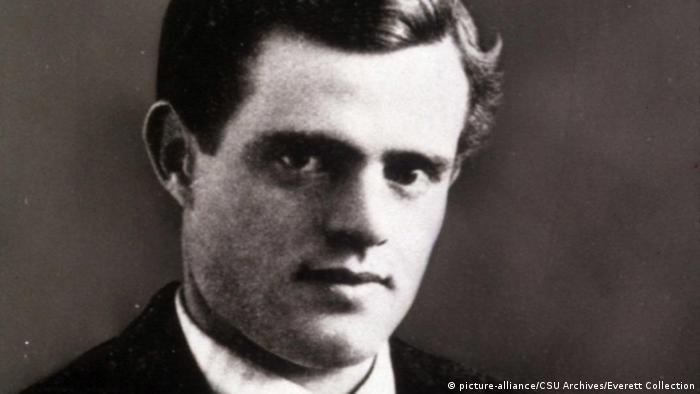
With more than 20 novels, several autobiographical works and a large collection of plays, essays, reports and short stories, Jack London was a prolific writer.
And, as his German biographer Alfred Hornung points out in a new work on the American author, London is still an immensely current figure today. In his book, Hornung points to the parallels between the crisis and challenges of London’s time, at the beginning of the 20th century, and today: “financial crises, the ethnic diversification of society, the clash between rich and poor and the reckless handling of power.”
London, of course, is known for his adventure stories – “The Call of the Wild” and “White Fang” being some of his best-known works.But the writer, who died at the age of 40 after a life of excess and half a dozen serious illnesses, was more than just an adventure writer – although he was a master of the genre. On the 100th anniversary of the death, DW takes a closer look at a few of his other accomplishments.
London’s travels on the Snark inspired many of his stories
‘Martin Eden’
To learn about the life of the famous author, check out this semi-autobiographical novel published in 1909.
In “Martin Eden,” the eponymous main character begins the book as a rather coarse adventurer who, fascinated by the world of education and books, decides to become a writer. He is inspired by (and falls in love with) Ruth Morse, a young university student from a completely different social background.
The novel is a fine example of London’s writing. In the tradition of the great novelists of the 19th century, London precisely describes the feeling of having an alert and interested mind stuck in an unpolished, coarse body. “Martin Eden” shows both sides of London’s character: adventure and intellect.
‘South Sea Tales’
Like “Martin Eden,” this collection of tales set in the South Seas was written onboard his yacht, the Snark. London was able to create authentic and vivid stories because he had previously visited the islands and their inhabitants on his travels. But the South Sea stories aren’t just dry, descriptive texts.
In “The House of Mapuhi,” for example, London tells the story of native pearl fishers, Europeans with dollar signs in their eyes, and an ominous storm that destroys the dreams for happiness and a better life. It’s a breathtaking work, showing off the clash between nature and civilization.
‘The Cruise of the Snark’
London bought himself the aforementioned Snark following the success of his early adventure novels. The author, along with a small crew and his wife Charmian Kittredge, planned to go on a seven-year tour around the world.
In the end, the trip only lasted two years, mainly because many things went wrong and London contracted several serious illnesses. Most of the time, almost everyone onboard the ship was sick, he wrote. Added to this was alcoholism, which accompanied London for his entire life. He wrote about all this in his 1911 travel report, and was quite open and unashamed.
The 1969 thriller “The Assassination Bureau,” starring Oliver Reed, was based on an unfinished work by Jack London
‘The Assassination Bureau, Ltd’
This thriller came as a surprise to many Jack London fans: An unfinished book, completed by American crime writer Robert L. Fish, was published in 1963 and based on an original idea from Nobel-laureate Sinclair Lewis. London wrote about 200 pages of the book in 1910 before abandoning the project; Fish completed the last 50.
The story, which follows a secret organization that assassinates evildoers, was turned into a 1969 movie starring Diane Rigg, Oliver Reed and Telly Savalas. “The Assassination Bureau, Ltd” is a quick read and full of surprises, shifting between philosophical treatise and chilling spy story.
It cries out for a remake, preferably by British director Guy Ritchie, known for his movies filled with hustlers, oddballs and black humor. London would probably be a big fan of such a film today.
From https://storyembers.org/two-compelling-ways-to-weave-themes-into-short-stories/:
2 Compelling Ways to Weave Themes into Short Stories
May 6, 2021

Gabrielle Pollack
For years, short stories remained cloaked in mystery for me. I hadn’t the slightest idea how to write one, much less imbue a theme into it. I stumbled in the dark, creating tales and hoping themes would magically appear.
Shocker: that didn’t happen. But working on themes in my stories wasn’t important, right?
I submitted my first short story to an online magazine and realized that theme is indeed essential. It adds meaning and depth, and if done right, can be incredibly powerful. I often neglected to include themes in my stories because I didn’t concentrate on my characters’ beliefs or carefully consider POV choices. I only started understanding more about short stories after many painful failures, revisions, and more failures.
Incorporating themes into short stories doesn’t have to be painful (or mysterious). If you pay attention to your characters and POV, you can avoid many of the pitfalls I’ve discovered.
Make Every Character Count
Other than the protagonist, your story won’t have room for many round characters, but each one must believe something about the theme—and side characters can’t hold any ol’ stance. They must serve to demonstrate what will befall the protagonist if he follows their paths and imitates their choices. Ideally, at least one side character should either experience the opposite version of the protagonist’s arc or have already lived through the consequences of her decisions. If all the characters have similar mindsets, you’ll only reveal one side of the story.
For example, say you want to write a short story about a college student named Samuel who has the power to manipulate time. He accidentally twists the space-time continuum by using his gift to freeze the clock and cheat on an exam. Each character in this story must relate to the theme, which revolves around the morality of cheating.
The message could be summarized like this: if you cheat, you lose more than you gain. Samuel’s girlfriend cheated her way through college. She was caught a few months ago, and after being expelled, she must retake several classes she “passed” at another college. Unchanged, she encourages Samuel to cheat and embodies the dangers of forsaking academic integrity. His best friend, on the other hand, studies hard and is prepared for every test, so he has no need to cheat. These characters show Samuel the results of different choices and draw out various facets of the theme. Each interaction with these characters provides a chance to confront Samuel’s beliefs and push him to accept one opinion or the other.
Integrate Theme into Point of View
For a short story to flourish, the main elements of storytelling must be utilized to the fullest, including POV. Theme must be infused into whatever POV you settle on.
Each POV character has a unique ability to underscore a part of your theme. A short story usually features characters who either haven’t yet faced the thematic question, are in the middle of dealing with it, or have already answered it. A character’s position in the progression of his arc determines whether his POV can naturally emphasize the theme.
Think about it. If a character has decided what he believes, he won’t hesitate to assert that he’s right and take action. A character who is wrestling with the theme will be torn between options. He’ll move more slowly.
Telling a short story through the eyes of a character who changes is generally the easiest way to communicate a theme. In a short story, you need to devote time to internal battles and questions. Struggles not only prompt readers to ask questions alongside the character but also help them relate to his doubts. This builds empathy and engages readers within a small time span. Other perspectives can highlight aspects of the theme, but a transformative arc often has the most impact in the least amount of pages.
Samuel has plenty at stake. If he admits he cheated and embraces the consequences, he might damage his academic record—or even lose his ability to manipulate time. The theme will feel integral and compelling because it directly applies to his life.
From https://www.helpingwritersbecomeauthors.com/use-theme-to-create-character-arc/:
5 Ways to Use Theme to Create Character Arc (and Vice Versa)

What’s the easiest way to find your story’s theme—and make it stick? Although any discussion of theme is multi-faceted, one of the best ways to approach this complex topic is through the realization that you can use theme to create character arc—and vice versa.
When asked to explain what a particular story is about, some people may respond with a plot answer: “It’s about the end of the world.”
Others may even respond with a theme answer: “It’s about whether it’s morally acceptable to save a few at the cost of the many.”
But implicit within either answer is character.
Indeed, the third possible answer is, of course, straight-up about the characters: “It’s about astronauts.”
The end of the world and its incumbent moral quandaries are hardly interesting unless people are involved. (Or at least anthropomorphic entities. Watership Down, after all, is an extremely engaging apocalypse.)
Identifying Your Story’s Text, Context, and Subtext
So am I saying story is really character? ‘Cause a couple weeks ago, I said story is really theme. So… what gives?
If theme is a story’s soul and plot is its mind, then character is its heart. Character is always and ever the life force of story. But what is life without meaning? Even in stories that wish to posit the meaning of life is there is no meaning, that’s still a meaning. That’s still a theme.
The bottom line is you can’t have a proper story without people (characters) doing stuff (plot)—the very highlighting of which inevitably comments upon reality (theme).
Together, this trinity of storytelling mutually generates the text, context, and subtext.
The outer conflict, represented by plot, exists on the story’s exterior and most visual level. This is the text.
The inner conflict, represented by character arc, exists on the story’s interior level. This is the context. It provides the first layer of commentary on the plot’s events. When viewed through the differing context of different characters’ inner struggles, a plot’s text can take on many different meanings.
Finally, the story’s theme nestles in the center of the Venn. It may never be seen; it may never be explicitly spoken of or referenced. But even silent, it creates the subtext. Depending on how the other two elements are presented, this subtext may either cohesively support or ironically juxtapose the story’s text and context.

In short, it would seem the character’s personal relationship with the plot events is what creates the thematic subtext. This is 100% true. But if viewed from another vantage, it becomes clear that an aware author can also shape the story in the opposite direction by consciously using theme to create character arc.
5 Steps to Use Theme to Create Character Arc
Effective character arcs are inherently related to thematic presentation. This means all discussions of character arc are really discussions of theme. Character arc is, in itself, a deep and complex subject, which I’ve explored in many other posts and, of course, my book Creating Character Arcs (and its companion workbook). For the sake of expediency, today’s post assumes a basic understanding of character-arc principles, but if you want more info, check out the preceding links.
Today, I want to talk specifically about how theme creates character arc and/or character arc creates theme (depending which end the author tugs first). I’m necessarily talking about each of these aspects in partial isolation. Two weeks ago, we talked about how to identify your thematic premise; next week, we’ll talk about manifesting theme in the outer conflict of your story’s plot. But don’t forget that each is part of the larger symbiosis.
None of these three elements—theme, character, and plot—is created in isolation. Instead, the author must employ what I call the “bob and weave.” If you have a notion about what you want your theme to be, you might start by investigating how that could play out in the plot, which might prompt you to start developing suitable characters, which might bring you back to questions of plot—and on and on, back and forth, back and forth. For every little bit you develop theme, you must develop character and plot apace.
So how can you use theme to create character arc? And how can you use your character’s arc to help you identify and solidify your theme? Following is a five-part checklist that will help you identify the thematic pieces already at play and then use them to generate further ideas that will harmonize your story into a single unified idea.
1. The Thematic Premise’s Explicit Argument
As we talked about in this post, the essence of your theme will be summed up in its thematic premise. There are many ways this premise might be expressed—everything from a single word to a fully-realized sentence. When using the thematic premise to develop character arc, the central tenet you’re most interested in is its argument.
Implicit within even the most amoral thematic premise will be a central question. That question is going to produce the heart of your protagonist’s character arc. This is the question that will drive his quest throughout the story. The answer may end up being explicit (as with Dorothy Gale’s “there’s no place like home”), or it may be deeply implicit (as we talked about previously with The Great Escape‘s “the human spirit is indomitable”). Either way, the search for this answer will define your protagonist’s inner conflict.

For Example:
- In Charles Dickens’s A Christmas Carol, the thematic premise’s argument might be turned into the question: “What determines the worth of a life?”
- In Charles Portis’s True Grit, the thematic premise’s argument might be turned into the question: “Is justice a personal responsibility?”
- In Mario Puzo’s The Godfather, the thematic premise’s argument might be turned into the question: “Does defense of one’s family justify all means?”
2. Inner Conflict, Pt. 1: Lie vs. Truth
A story’s theme is a posited Truth about life. This Truth may be inherently moral (“what does it mean to be a good person?”), or it may be existential (“what is life all about?”). Either way, the story will indicate that a certain Truth is, indeed, true.
Necessarily, where there is a proposed Truth, there must also be opposing un-truths—or Lies. And how does a story explore these Truths and Lies? Not, your readers sincerely hope, through lengthy, sermon-y exposition, in which they are told what’s what and what’s not. Rather, readers want to be shown. They want to see your proposed Truth acted out in a realistic simulation. Whether the proposed Truth can hold up under stressful reality will be “proven” (or disproven) by how well that Truth and its opposing Lies serve your character over the course of the story.
Your story’s outer conflict will deal with outer antagonists—people and situations that throw up obstacles between the protagonist and the larger story goal. The inner conflict, however, is ultimately a battleground of the mind, heart, and soul.
No matter what type of arc you’re using (Positive Change, Flat, or Negative Change), the story’s central Truth will be the crucial piece needed for the characters to achieve positive ends within their quests. If they resolve their inner conflicts by embracing the Truth, the outer conflict will follow suit. If they cling to the Lie and prove unable to embrace the Truth, their external pursuits will end in, at best, hollow victories.
For Example:
- In A Christmas Carol, Ebenezer Scrooge overcomes his Lie that “the worth of a life is measured in money” and embraces the Truth that “the worth of a life is measured in charity and goodwill.”

- In True Grit, Mattie Ross’s steadfast Truth that “a careless attitude about justice will create social anarchy” creates measurable change in the world and characters around her.
- In The Godfather, Michael Corleone ends by embracing the Lie that “corruption and violence are a justified means to an end.”
3. Inner Conflict, Pt. 2: Want vs. Need
If we climb up another rung on the story ladder from Abstract Theme toward Concrete Plot, we find the next level in your character arc’s development. The story’s central inner conflict between Lie/Truth will translate directly into the character’s Want/Need.
The Lie is rooted in or is the catalyst for one of the character’s central Wants. In Change Arcs, this Lie-driven Want will probably directly influence the character’s plot goal. In a Flat Arc, the protagonist will already believe in the story’s Truth, but will have to contend with the Wants of other characters whose adherence to the central Lie will create external obstacles.
At its broadest, the Need is always the Truth. What any Lie-believing character Needs is the Truth. But, like the Want, the Need will often translate into a literal object, person, or state within the external plot.
For Example:
- In A Christmas Carol, Scrooge Wants to “make as much money as possible.” What he Needs is the love of his fellow human beings.
- In True Grit, Mattie’s Want of “bringing her father’s killer to justice” is in alignment with the Need of the world around her, but is obstructed by the moral apathy of the lawmen she hires to help her.

- In The Godfather, Michael Wants to protect his criminal family. What he Needs is to leave the life of crime behind him.
4. Inner Conflict Becoming Outer Conflict
Your character’s inner conflict cannot exist in a vacuum. The inner conflict must be caused by and, in turn, must cause the outer conflict. This is a direct development of the Want/Need. In order to bring all of the Big Three—theme, character, and plot—into alignment, the Lie/Truth must be expressed as the Want/Need.
Depending on the nature of your story and the type of arc you’ve chosen for your characters, they will likely be forced to choose between what they Want and what they Need. This will be the externalized metaphor that proves the corresponding choice between the theme’s Lie and Truth. Readers will never need to be hit over the head with a “moral of the story” when they can be shown a character’s wrenching choice between two concrete objects, people, or states of being.
This decision should never come easily. If the posited “right” choice is obviously better than the “wrong” choice, the thematic argument will lack teeth. If the right choice is easy, why should the character need to experience any inner conflict at all? This is why the argument between Lie and Truth must truly be an argument. If a Truth that posits “murderers are evil” is opposed by the simplistic Lie that “murderers are good”—there is no argument. But if the Lie is complex enough to allow the author to explore why, for instance, a defense lawyer might truly believe her psychopathic client deserves not to be punished—then suddenly, you have an interesting premise that can be played out in the external conflict with extremely high stakes.
For Example:
- In A Christmas Carol, Scrooge must choose between facing the monumental weight of his wasted life or going to his grave unperturbed.
- In True Grit, Mattie must choose between pursuing her father’s killer and her own safety.
- In The Godfather, Michael must choose between living a righteous life or protecting his family by any means.

5. Change Within the Character, Change Within the Plot
The surest way to check whether your theme is in harmony with your characters (and, therefore, your plot) is to hone in on what changes within your story. How are the characters—particularly the protagonist—different at the end of the story from how they were at the beginning? If there are no changes, then the storyform will be fundamentally problematic.
Another problem may arise when the character changes, but not in alignment with the thematic premise. This is a sign of a disconnect at some point in the story. Even if you’ve attempted to paste a different theme over the top, what your story is really about is always rooted in the change that occurs in your characters and their world.
When we see theme fully integrated with other story elements, that theme will always be an active force, either working change upon the protagonist or worked by him upon other characters.
For Example:
- In A Christmas Carol, Scrooge changes from a miser in the story’s beginning to a repentant, joyous, and charitable man in the end.
- In True Grit, Mattie has wrought change upon the world around her, bringing an end to her father’s murderer and the outlaw gang he ran with, as well as inspiring actions in the complacent and self-serving lives of the lawmen she encountered on her journey.
- In The Godfather, Michael changes from a clean-cut young war hero with a legitimate career to a ruthless mafia don.
***
When theme is a message imposed upon a story, the result often feels disconnected or even heavy-handed. But when the author works with the theme via the characters, the story’s Truth will arise beautifully and powerfully as part of an organic whole.
From https://www.nownovel.com/blog/theme-examples-from-literature/:
How to develop story themes: 5 theme examples
by Jordan

The recurring ideas or broad themes of books give us insights into ideas such as ‘love’, ‘honour’, ‘good vs evil’ and much more. Read 5 theme examples from books that show how to take your story’s ‘big ideas’ and use them to create additional characters and subplots:
First, what is a theme?
To begin by defining theme, a theme is:
‘An idea that recurs in or pervades a work of art or literature’ (Oxford English Dictionary).
This could be, for example, a general idea or theory, such as ‘all people are inherently selfish’ (although a pessimistic one). Or we may speak of theme in even broader terms. A reviewer might say an author examines themes of ‘crime and punishment’. The events of the story in question might make us ask, ‘Why do criminals break the law?’ or ‘What is the real purpose of punishing a crime?’
Most books explore a single theme (or more) from multiple angles, through multiple story scenarios.
In The Lord of the Rings, for example, the theme ‘power corrupts’ isn’t only shown through the tyranny of the main villain, Sauron. Tolkien also shows this theme in the fall from grace of Gollum, who kills to gain possession of the One Ring. We also see the switch in allegiance of the wizard Saruman. We see, again and again, the corrupting aura of unbridled power.
Through the ways authors illustrate and expand novel themes, we begin to understand the ‘message’ of their books, or rather the beliefs, concepts (e.g. ‘power corrupts’), values or ideals a story explores. [You can brainstorm ideas for your themes using Now Novel’s step-by-step story prompts. Or share your ideas for thematic development in Now Novel groups.]
Themes also tend to go together. Because loving another person also means risking loss, for example, love stories often feature loss. As Nicholas Sparks says:
‘In all love stories the theme is love and tragedy, so by writing these types of stories, I have to include tragedy.’
Now that we’ve unpacked what ‘theme’ is, here are 7 examples from books of how authors develop themes. Read how authors explore theme to create satisfying, structured stories:
5 theme examples from novels and their development
1: Power and corruption in The Lord of the Rings
J.R.R. Tolkien’s iconic epic fantasy cycle is an excellent example of skilled story theme development.
We meet Tolkien’s main themes already in the first book’s prologue. Tolkien shares how the antagonist Sauron forged the One Ring but in doing so created the seeds of destruction.
How Tolkien develops the story theme ‘power corrupts’
Tolkien introduces the theme of ‘power corrupts’ in the prologue, and extends it.
Déagol, a river-dweller, finds the One Ring that has been lying lost in a river bed 2000 years after its creation. His friend Sméagol (later Gollum, named after the guttural gulping sound he makes) covets the ring and murders him, wanting it for himself.
Tolkien shows throughout the remainder of the fantasy cycle how the ring’s power brings out his characters’ baser, uglier instincts. He sustains his thematic focus by showing how the ring’s power tests and tempts his characters. Through these multiple instances of betrayal and temptation, we understand that giving in to the darker temptations of power comes at a price.
Tolkien further develops the ‘power corrupts’ theme in the fate of the One Ring. The necessary destruction of the ring becomes a key plot point, yet accomplishing the task is not an easy feat. The journey to Mount Doom the characters have to undertake is perilous. Thus Tolkien shows the tenacity required to stand up to corrupt power. This theme thus connects to other, related ideas (e.g. ‘power corrupts but the brave can withstand temptation and suffering to overcome it’).
Tolkien develops the story’s themes of power and corruption by:
- Creating illustrative characters and events (The One Ring’s creation; Sméagol’s corruption and murder of his friend, etc.)
- Using additional characters and events to create ‘ifs’, ‘buts’, and other exceptions. E.g. ‘Power corrupts but the brave or virtuous can withstand temptation’
As you write, think about how scenes can develop your biggest themes. What could additional scenes illustrate about an idea such as ‘power corrupts’ or ‘love conquers when people have faith’?
2: Themes of crime and ‘circumstantial morality’ in Crime and Punishment
The title of the Russian author Fyodor Dostoevksy’s Crime and Punishment tells us its primary themes. The main character Rodion Raskolnikov is a poor university student who kills a stingy pawnbroker. He rationalizes his murder by seeing it as a service to the many people at the mean pawnbroker’s mercy.
Yet, in the act, the pawnbroker’s sister surprises Rodion and he kills her too. She is not part of his plan and is, by comparison, undeniably kind and faultless. This development is crucial as Raskolnikov is driven to deeper madness by guilt. He has rationalized one killing to himself, but the presence of the sister does not fit even the circumstantial morality he’s created for himself.
How Dostoevsky develops his story themes of ‘crime’ and ‘circumstantial morality’
Throughout the story, Dostoevsky introduces other characters and situations besides the events that unfold around the killing. These deepen his themes.
For example, Rodion meets a drunk, then later the man’s desperate, impoverished family. When the drunk is trampled to death by a horse, the protagonist ‘donates’ the money he stole after murdering the pawnbroker to the man’s panicked widow to help her pay for the funeral.
We thus see kindness and empathy in a ‘criminal’ character that call black-and-white judgments into question. We see how Rodion’s deeds are determined, in some part, by the situations he finds himself in. This contradicts the idea that characters are purely ‘good’ or ‘bad’. We realize that the same person can be capable of great cruelty and violence and also of acts of kindness.
This theme (of ‘goodness’ and ‘wrongdoing’ co-existing in the same person, depending on the circumstances) is developed further in a secondary character’s arc.
A daughter of the dead drunk man turns to prostitution to support her family. Dostoevsky takes great care to show her kindness, selflessness and desire to help. We see how characters can do things their broader society may consider horrific while still holding positive qualities. We see how people’s circumstances can be the only things standing between them and being true to society’s (or their own) values.
Dostoevsky thus expands his themes to create complex primary and secondary characters. Their internal contradictions challenge our assumptions and fixed beliefs.
To develop your own themes similarly, ask:
- What assumptions lurk in my themes? For example, ‘Only the brave survive’
- How can I challenge or deepen these ideas? For example, you could show one character who survives through bravery, while a second cowardly one also survives thanks to good luck and the kindness of others. Showing these differences creates multiple possible lessons and interpretations
3: Themes of love and loss in Nicholas Sparks’ The Notebook
As mentioned above, themes of loss often go hand in hand with romantic themes. Anyone who’s ever loved knows that there are many things that can separate lovers. Changes in values and desires, infidelity and betrayal, external circumstances (whether interference by others or unavoidable distance) and more.
In Nicholas Sparks’ novel The Notebook, themes of love (and what love requires to flourish: Perseverance, faith, commitment and courage) are just as pervasive as themes of loss.
How Sparks develops novel themes of ‘love’ and ‘loss’ in The Notebook
Sparks first introduces loss as a theme when the narrator, an old man, tells an old woman in a nursing home the story of a summer romance between Noah (a laborer) and a wealthy girl, Allie.
The two part because Allie’s family is only vacationing in Noah’s city. Over the following year, Allie’s disapproving mother intercepts the letters Noah writes to Allie. There is loss of communication, caused by external forces.
Sparks piles on loss after loss. Noah serves in World War II, creating even greater geographical distance between he and Allie, for example. The theme of loss develops further [major spoiler alert] when Sparks reveals that the old man telling the story is Noah and the old woman is Allie, now losing her memory.
Sparks uses successive states of loss this way to show the bravery and ‘being there’ – in spirit – loving another person requires. A secondary, optimistic theme follows this. The theme that love endures (despite setbacks, despite even non-recognition by the other) when the lover is able to keep faith.
To grow your themes as Sparks does, as you write your novel:
- Plan scenes that show the ideas of your emerging themes through different incidents. For example, Allie’s interfering mother and the war both show that love needs to withstand external divisive factors to endure
- Think about the ‘ifs’, ‘buts’ and ‘therefores’ that follow on from themes. For example ‘Sometimes love is enough … BUT external forces (e.g. interference, aging and Alzheimer’s disease) are beyond our control’

4: Themes of honour in Homer’s Odyssey
One of the oldest surviving stories (it is thought to have been composed in the 8th Century BC as a spoken tale), The Odyssey is an excellent example of developed story themes.
The story tells of the hero Odysseus’ snaking journey home to the island of Ithaca after the ten-year Trojan War.
The story opens with the Greek Gods discussing Odysseus’ long journey and how, because he is honorable, he deserves their aid travelling home.
How The Odyssey develops the theme of ‘honour’
Before we read Odysseus’ travels and trials, we see his son Telemachus and wife Penelope back home in Ithaca.
Suitors, convinced Odysseus’ has been killed and will not return, badger Odysseus’ wife to choose one of them to remarry.
Homer continues the theme of honour (and the related themes of duty and revenge) by showing the suitors being dishonourable. They eat Odysseus out of house and home in his absence, showing no respect. Telemachus warns them that if they don’t quit the family home voluntarily, there’ll come a day when they’ll face retribution.
The theme of honour is developed further. For example, Odysseus’ faithful wife fears his death, but without confirmation she refuses to remarry. To deter the suitors, she tells them she will weave a shroud and can only consider their proposals when it is complete. Yet every night, by torch-light, she unpicks the previous day’s work, to put the suitors off longer.
This detail adds another dimension to the theme of honour. it shows that sometimes, a usually dishonourable act (deceiving others) is necessary to uphold a greater honourable choice (Penelope’s decision to remain loyal to Odysseus, to have faith).
Homer’s development of the theme of ‘honour’ thus adds nuance to our understanding. We see, for example, in Penelope’s necessary deception, the idea that we should honour only those who treat us honourably themselves.
5: Themes of the dark side of science, technology and ‘progress’ in Margaret Atwood’s Oryx and Crake
Margaret Atwood’s novel Oryx and Crake explores a post-apocalyptic world where science without ethics almost kills the entire human race.
Atwood creates a world where multinational corporations rule, showing the devastation relentless pursuit of profit and ‘progress’ can wreak.
How Atwood develops themes of ‘the dangers of technological progress without responsibility’
As a child, the protagonist, Jimmy (who later becomes known as Snowman) has a friend Crake and the two watch videos such as live executions together. Early scenes in the book show the dark side of the sheer variety of information we now have access to.
Jimmy and his friend grow up in a world where developing a keen sense of right and wrong is hard. Individuals have more freedom, but with that comes more power and responsibility.
As the novel progresses, we see more of how people have brought about their own ruin. Jimmy/Snowman reveals [spoiler alert] that Crake became a bio-engineer, creating a drug that in turn created a fatal global pandemic.
To develop her primary, dystopian themes, Atwood:
- Creates two character paths that diverge: Jimmy/Snowman retains his awareness and compassion whereas Crake pursues discovery and power regardless of the cost
- Imagines an end-game: What if ‘progress’ and ‘profit’ replace all ethical standards and concerns, without checks and balances?
Atwood takes her novel’s theme (the danger of technological progress without responsibility or humanity) and pushes it to a conclusion that shows how much is at stake.
To develop your own story themes to end-points as Atwood does:
- Ask ‘what would happen if’: For example, if your theme were ‘love conquers all’, how could you continue to show this if one character (like Allie in The Notebook) lost their memory? Sparks does this by having Noah read Allie their personal history as though it is a fable, still wishing to share what they’ve created together
- Brainstorm ideas for end-games: What is the final result of your theme developing to a conclusion? For example, if ‘power corrupts’, either the powerful’s abilities must have checks and balances, or people (your characters) suffer the consequences
From http://terribleminds.com/ramble/2011/09/26/25-things-writers-should-know-about-theme/:

The Ramble 65 comments 25things, advice, writing
25 Things Writers Should Know About Theme

September 26, 2011

1. Every Story Is An Argument
Every story’s trying to say something. It’s trying to beam an idea, a message, into the minds of the readers. In this way, every story is an argument. It’s the writer making a case. It’s the writer saying, “All of life is suffering.” Or, “Man will be undone by his prideful reach.” Or “Love blows.” Or, “If you dance with the Devil Wombat, you get cornholed by the Devil Wombat.” This argument is the story’s theme.
2. The Elements Of Story Support That Argument
If the theme, then, is the writer’s thesis statement, then all elements of the story — character, plot, word choice, scene development, inclusion of the Devil Wombat — go toward proving that thesis.
3. Unearthed Or Engineered
The theme needn’t be something the writer is explicitly aware of — it may be an unconscious argument, a message that has crept into the work like a virus capable of overwriting narrative DNA, like a freaky dwarven stalker hiding in your panty drawers and getting his greasy Norseman stink all over your undergarments. A writer can engineer the theme — building it into the work. Or a writer can unearth it — discovering its tendrils after the work is written.
4. Theme: A Lens That Levels The Laser
Knowing your theme can give your story focus. If you know the theme before you write, it helps you make your argument. If you discover the theme before a rewrite, it helps you go back through and filter the story, discovering which elements speak to your argument and which elements are either vestigial (your story’s stubby, grubby tail) or which elements go against your core argument (“so far, nobody is getting cornholed by the Devil Wombat”).
5. Do I Really Need This Happy Horseshit?
Yes and no. Yes, your story needs a theme. It’s what elevates that motherfucker to something beyond forgettable entertainment. You can be assured, for instance, that 90% of movies starring Dolph Lundgren have no theme present. A story with a theme is a story with a point. No, you don’t always need to identify the theme. Sometimes a story will leap out of your head with a theme cradled to its bosom (along with the shattered pottery remains of your skull) regardless of whether or not you intended it. Of course, identifying the theme at some point in your storytelling will ensure that it exists and that your story isn’t just a hollow scarecrow bereft of his stuffing. Awww. Sad scarecrow. Crying corn syrup tears.
6. Slippery Business
I make it sound easy. Like you can just state a theme or find it tucked away in your story like a mint on a pillow. It isn’t. Theme is slippery, uncertain. It’s like a lubed-up sex gimp: every time you think you get your hands around him the greasy latex-enveloped sonofabitch is out of the cage and free from your grip and running into traffic where he’s trying desperately to unzipper his mouth and scream for help. Be advised: theme is tricky. Chameleonic. Which isn’t a word. But it should be. It jolly well fucking should be.
7. For Instance: You Can Get It Wrong
You might think going in, “What I’m trying to say with this story is that man’s inhumanity to man is what keeps civilization going.” But then you get done the story and you’re like, “Oh, shit. I wasn’t saying that at all, was I? I was saying that man’s inhumanity to cake is what keeps civilization going.” And then you’re like, “Fuck yeah, cake.” And you eat some cake.
8. Mmm, Speaking Of Cake
In cake, every piece is a microcosm of the whole. A slice contains frosting, cake, filling. Okay, that’s not entirely true — sometimes you get a piece of cake where you get something other pieces don’t get, like a fondant rose, but really, let’s be honest, fondant tastes like sugary butthole. Nasty stuff. So, let’s disregard that and go back to the original notion: all pieces of cake contain the essence of that cake. So it is with your story: all pieces of the story contain the essence of that story, and the essence of that story is the theme. The theme is cake, frosting, filling. In every slice you cut. Man, now I really want a piece of cake.
9. Grand Unification Theory
Another way to look at theme: it unifies story and bridges disparate elements. In this way theme is like The Force. Or like fiber. Or like bondage at an orgy. It ties the whole thing together. Different characters, tangled plotlines, curious notions: all of them come together with the magic motherfucking superglue of theme.
10. Put Down That Baseball Bat, Pick Up That Phial Of Poison
Theme can do a story harm. It isn’t a bludgeoning device. A story is more than just a conveyance for your message: the message is just one component of your story. Overwrought themes become belligerent within the text, like a guy yelling in your ear, smacking you between the shoulder blades with his Bible. Theme is a drop of poison: subtle, unseen, but carried in the bloodstream to the heart and brain just the same. Repeat after me, penmonkeys: Your story is not a sermon.
11. No Good If Nobody Knows It
The poison is only valuable if the victim feels the effects. Your big dick or magical vagina only matter if people can see ’em, touch ’em, play with ’em, erect heretical idols to their glory (mine is cast in lapis lazuli and a nice sharp cheddar cheese). So it is with theme: a theme so subtle it’s imperceptible does your story zero good. It’d be like having a character that just never shows up.
12. Triangulating Theme
Ask three questions to zero in on your theme: “What is this story about?” “Why do I want to tell this story?” “Why will anyone care?” Three answers. Three beams of light. Illuminating dark spaces. Revealing theme.
13. As Much An Obsession As A Decision
The auteur theory suggests that, throughout an author’s body of work one can find consistent themes — and, studying a number of authors, you’ll find this to be true. (Look no further than James Joyce in this respect, where he courts themes exploring the everyday heroism of the common man competing against the paralysis of the same.) In this way theme is sometimes an obsession, the author compelled to explore certain aspects and arguments without ever really meaning to — theme then needn’t be decided upon, nor must it be constrained to a single narrative. Theme is bigger, bolder, madder than all that. Sometimes theme is who we really are as writers.
14. Theme Is Not Motif
I’ll sometimes read that theme can be expressed as a single word. “Love.” “Death.” “Plastics.” Let me offer my own one word to that: bullshit. Those are motifs. Elements and symbols that show up again and again in the story. Motif is not synonymous with theme. “Death” is not a theme. “Man can learn from death” is a theme. “Life is stupid because we all die” is a theme. “Sex and death are uncomfortable neighbors” is a theme. Death is just a word. An inconclusive and unassertive word. Theme says something, goddamnit.
15. Mmm, Speaking Of Cake, I Mean, Motif
That said, motif can be a carrier for theme: theme is the disease and motif is the little outbreak monkey spreading it. If your theme’s making a statement about death, then symbols of death would not be unexpected. Or maybe you’d use symbols of time or decay. I mean, it has to make sense, of course. A theme about what man can learn from death is not well-embodied by, say, a series of microwave ovens.
16. Theme Is Also Not A Logline
A logline is plot-based. It depicts a sequence of events in brief, almost vignetted, form. Plot embodies breadth. Theme embodies depth. Theme is about story, and story is the weirder, hairier brother to “plot.”
17. Piranhasaur Versus Mechatarantula
In English class, I was often told that theme could best be described as X versus Y. Man versus Nature. Man Versus Man. Man Versus Woman. Fat Guy Versus Hammock. Of course, English class was frequently fucking stupid. Once more I’m forced to call bullshit. Theme isn’t just you, the writer, identifying a struggle. That’s not enough. Theme picks a goddamn side. Theme asserts predictive outcome. It says, “In this struggle, nature always gets the best of man.” It predicts, “That hammock is going to fuck that fat guy up, for realsies.” Theme does more than merely showcase conflict. Theme puts its money on the table.
18. Take That Question Mark And Shove It Up Your Boothole
So too it is that theme is never a question. “How far will man go for love?” is a question, not a theme. Theme isn’t a big blank spot. Theme is the fucking answer, right or wrong, good or bad.
19. It Is The Question, However, That Drives Us
Plot can carry theme by asking the question — like the aforementioned, “How far will man go for love?” — but then it’s theme’s job to stick the landing and, by the end of the story, answer the question posed. Theme comes back around and demonstrates, “This is how far man will go for love.” It shows if man will go into the whale’s mouth and out the whale’s keister, or it shows it man has limitations, or if man’s love can be defeated by other elements (greed, lust, fear, microwave ovens, wombats).
20. Of Turtleheads And Passing Comets
Theme might end up like Halley’s Comet — once or twice in a story, it emerges from hiding and shows itself. The blood test reveals it and The Thing springs forth from flesh. In this way, it’s okay if the theme is plainly stated (often by a character) once or twice in the story. Forrest Gump tells us that life is like a box of chocolates, you never know what you’re gonna get. (And the film is like a box of chocolates, too — all the shitty ones filled with suntan lotion and zit cream.) The opening line to Reservoir Dogs could be argued to give away the whole point to the movie: it is, after all, a metaphor for big dicks.
21. Do Your Due Diligence
Read books. Watch movies. Play games. Find the theme in each. This isn’t like math. You may not find one pure answer to the equation. But it’s a valuable exercise just the same. It’ll teach you that theme works.
22. Your Audience Might Not Give A Shit (But That’s Okay)
Theme may not be something the audience sees or even cares about. Further, the audience may find stuff in your work you never intended. Like that old joke goes, the reader sees the blue curtains as some expression of grief, futility and the author’s repressed bestiality but, in reality, the author just meant, “The curtains are fuckin’ blue.” It’s all good. This is the squirmy slippery nature of story. That’s the many-headed hydra of art.
23. Not Just For Literary Noses Held High In The Air
Just the same, theme isn’t a jungle gym found on a playground meant only for literary snobs. Theme speaks to common experience and thus is for the common reader and the common writer. Theme isn’t better than you and you’re not better than theme. Like in Close Encounters, this is you mounding your mashed potatoes into an unexpected shape. “This means something.” Fuck yeah, it does. That’s a beautiful thing.
24. A Weapon In Your Word Warrior Arsenal
How important is theme at the end of the day? It’s one more weapon in your cabinet, one more tool in your box. It is neither the most nor the least most important device in there — you determine its value. My only advice is, it helps to get floor-time with every weapon just so you know how best to slay every opponent. Play with theme. Learn its power. I mean, why the hell not?
25. For Fuck’s Sake, Say Something
You want theme distilled down? You want it reduced like a tasty sauce? Theme is you saying something with your fiction. Why wouldn’t you want to say something? Big or small, simple or complex, as profound as you care to make it, fiction has the power to do more than just be a recitation of plot events. Your work becomes your own — fingerprinted in blood — when you capitalize on the power of storytelling to speak your heart and soul. Take a stand. Put your big dick and magic vagina on the line (figuratively speaking) and let theme be a bold pronouncement of confidence, a message encoded in the DNA of an already-great story.

 KC Storytellers