Jump to Section:
Examples of Anti-Villains from the Marvel Universe
What is an Anti-Villain? Definition, Tips, and Examples
A Song of Ice and Fire has held the hearts of fantasy-readers for the past 20 years, and Marvel movies have been dominating movie screens for a decade. So you might be wondering: what makes these franchises so compelling? The answer? Anti-villains.
These days, people want more than black and white characters (protagonists who are inherently good and antagonists who are inherently bad). They want flawed heroes who struggle to carry out their goals, and complex villains with backstories and motives that show their humanity. Enter: anti-heroes and anti-villains. In other words, characters who defy their literary conventions.
What is an anti-villain?
Anti-villains have noble characteristics, values, and goals, but how they strive for those goals is often questionable — or downright abhorrent. Like traditional villains, anti-villains stand in the way of the hero’s goal. But unlike a traditional “bad guy,” the anti-villain isn’t necessarily evil.
Anti-villains (or AVs, for brevity’s sake) make for interesting characters because they don’t fall into the good vs. evil dichotomy like traditional villains. Instead, they are morally gray. Their backstories give readers an insight into their motives — and while readers will still cheer for the hero to come out on top, they will also have some sympathy for the anti-villain’s motives.
Anti-hero vs. villain
The anti-villain is the character readers want to see vanquished, even though their redeeming qualities typically leave readers torn. In contrast, the anti-hero is the character readers root for, even though they’re flawed and possess some less-than-noble qualities. Simply put, anti-heroes are the opposite of anti-villains: they are protagonists who lack the conventional attributes of traditional heroes.
For example, Hercules is as traditionally heroic as they come: he has innate physical strength, is unflappably pure of heart, and determined to fight for the good of everyone. On the other hand, Lisbeth Salander from Steig Larsson’s Millennium series is decidedly not a conventional hero — she’s an anti-hero. A loner computer hacker, she’s driven primarily by vengeance. Lisbeth doesn’t give a second thought to applying “eye for an eye” to those who do her wrong — or even going a little bit beyond it. But she is also protective by nature, and her vengeful wrath is usually unleashed at “bad guys” who take advantage of the vulnerable. In other words, she does help people — but she might also derive a slightly twisted delight in enacting violence.
Types of anti-villains
Anti-villains are morally grey, but there are so many different shades of grey. No, not fifty. Here are four main types of quasi-miscreants you might stumble across in literature.
1. The Well-Intentioned Extremist
Both heroes and readers can probably agree that this type of anti-villain’s goal is, in principle, noble. But the way they go about trying to achieve it is simply wrong. No matter how much they might sympathize with the AV’s intentions, the hero has no choice but to stop them.
This kind of AV typically believes that to achieve their goal, they must take extreme measures. They also often adopt a “for the greater good” ethos. They convince themselves that, even though their objective may harm — or kill — tons of innocent people, the world will be better off for it in the end.
This type of anti-villain is popular these days, so reading this description is probably already bringing to mind a number of different examples. Such as…
Example: Thanos from the Marvel Cinematic Universe
Thanos’ goal to prevent the destruction of the universe is noble, but his methods were undeniably villainous.“Villain” — Thanos wants to eliminate half of earth’s population. In other words, to commit global genocide. To that end, he has been tracking down the “Infinity Stones” by any means necessary — even if that means murdering his own daughters to get them.
“Anti” — Thanos genuinely believes that committing global genocide will bring stability to the universe. He is worried about the future of the world: he foresees its massive and growing population eventually depleting all available resources, leading to its ultimate destruction.
2. The Noble Anti-Villain
This character is a villain, but not just for the sake of it: there’s a specific reason they have chosen to be the “bad guy.” The Noble Anti-Villain is commonly referred to as a “villain with code” — they have standards they’re not willing to break. Often, they’re more talk than action: they might be committed to villainy on the surface, but when push comes to shove, they struggle to actually follow through.
Example: Draco Malfoy from the Harry Potter series
Draco knows that to disobey Voldemort would result in his death — and his family’s. He’s also a villainous product of his evil upbringing, having grown up under the influence of his Death Eater parents. But, at the end of the day, he cannot bring himself to murder his defenseless headmaster.“Villain” —When his father fails a mission assigned to him by Lord Voldemort, Draco is given the perilous task of killing headmaster Albus Dumbledore. Throughout “The Half-Blood Prince,” Draco attempts to kill Dumbledore through various means, including a cursed necklace and poisoned mead.
“Anti” — All of Draco’s attempts to kill Dumbledore are ill-planned and fail easily. At the end of the novel, when he ambushes and disarms the weakened headmaster, Draco is easily talked down by Dumbledore: he lowers his wand, unable to carry out the murder. During “The Half-Blood Prince,” we see Draco struggle considerably with his mission, even having a nervous breakdown.
3. Villain in Name Only
A hero can’t exist without an antagonist to overcome. (And that antagonist doesn’t necessarily need to be another person.) Someone — or something — has to challenge them, prompting them to summon their heroic qualities for victory. Enter: the “Villain in Name Only.” As the moniker suggests, this person isn’t really evil — they just happen to oppose the hero. If the novel had been written from the perspective of the Villain in Name Only, they’d probably be the hero.
In general, the hero will acknowledge this AV’s lack of malicious qualities. This sparks a moral dilemma, since the hero still needs to bring the AV down.
Example: Javert from “Les Misérables”
Javert certainly plays the role of antagonist, constantly getting in the way of a happy ending for Jean. But he is driven by his dedication to the law above all else, not by an inherently evil character.“Villain” — Protagonist Jean Valjean has just spent 19 years in prison for stealing a loaf of bread. Finally, he is released by Javert, the man in charge of the prison workforce. When Jean breaks his parole, Javert vows to bring Jean to justice — and back to prison. Jean does manage to reinvent himself and his life, but his peace is constantly at threat by the relentless Javert.
“Anti” — While we root for Jean and wonder why Javert can’t just leave him alone, Javert isn’t really a “villain.” He does not wish to see Jean back in prison because of a personal vendetta, but because of his almost fanatical dedication to law and order.
4. The Woobie Villain
This character does not start out as a villain, but life makes them that way. Readers sympathize with this character as they watch the former “good guy” get pushed to their breaking point. At the end of the day, readers likely can’t sympathize with the Woobie Villains’ evil actions, but they’re moved to pity by the painful journey that took them there.
Example: Carrie from “Carrie”
Carrie wants what every teenager wants: supportive parents, friends, and the opportunity to fit in with their peers. She is not only denied all those things, she is abused and shunned at every turn. Had anyone been there for Carrie, prom would likely have turned out very differently.“Villain” — At a school dance, Carrie unleashes her telekinetic powers and kills everyone. She then continues her murder spree throughout her hometown.
“Anti” — Carrie is just a teenager trying to get on as best she can amidst some extremely (and increasingly) trying circumstances. Her mother is fanatically religious and makes Carrie feel like everything she does is sinful. She’s also fiercely bullied at school. One of the bullies takes pity on Carrie, convincing her boyfriend to ask Carrie to the school dance. However, other, less sympathetic bullies take advantage of the dance to dump a bucket of pig’s blood all over Carrie (and her homemade dress), further humiliating her in front of everyone. For the relentlessly abused Carrie, this is the final straw.
With these four morally gray “bad guys” covered, let’s take a look at a couple more great examples of compelling anti-villains from literature and film.
Anti-villain examples
If you try hard enough, you might be able to sympathize with more fictional villains than you expected. Okay, maybe not the horned king of fire and brimstone, Sauron, no matter how much you try to see the governance of Middle Earth from his point of view. But we bet the following anti-villain examples will have you revisiting other antagonists you love to hate with new eyes.
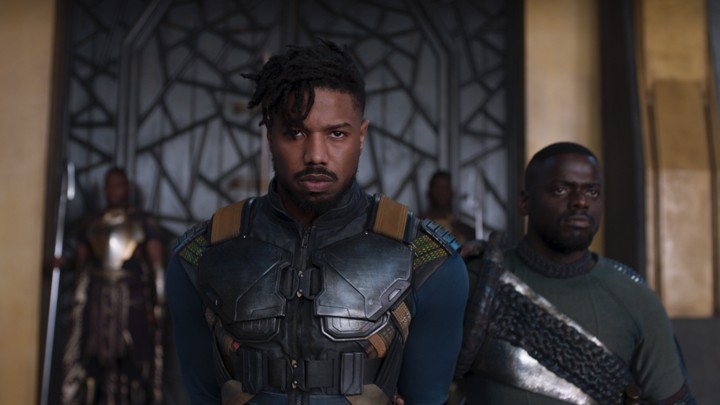
Example #1: Erik Killmonger from Black Panther
“Villain” — Erik is on a mission to carry out the work of his father. He wants to use Wakanda’s technologically advanced weapons to arm oppressed black people around the world. However, he plans to do this by taking totalitarian control over Wakanda and inciting worldwide violence — which goes directly against the Wakandans’ “strength through peace” mindset.
“Anti” — Well, it doesn’t take much imagination to picture a world where certain races have suffered centuries of systemic oppression. Erik is angry and wants to protect his people. He feels like fire is the best way to fight fire.
“Two billion people all over the world who look like us whose lives are much harder, and Wakanda has the tools to liberate them all,” Killmonger scolds the Wakandan court. “Where was Wakanda?”
Example #2: Brain from Pinky and The Brain
“Villain” — Is the Brain a lab-mouse who gained superhuman intelligence after being mutated in an experiment — who now wants to take over the world? Yes, and as we all know, world domination is a classic villain goal.
“Anti” — However, Brain is a mix of two types of anti-villains: 1) He’s a Well-Intentioned Extremist, since he wants to take over the world because he believes he could use his superior intellect to make it a better place. 2) He’s a Noble Villain because there are domination schemes too twisted for him to contemplate (like the one that involves selling cigarettes to children). The Brain’s relative humanity is highlighted by his nemesis Snowball, a hamster who also wants to take over the world, but is willing to sink to far crueler methods to do it.
“And I am the Iconoclast, an unconventional eccentric who marches to a different drummer… [whacked on head] but you may call me Noodle Noggin.”
Example #3: Daenerys Targaryen from Game of Thrones — *SPOILER WARNING*
“Villain” — If Martin tries to tell us anything throughout his series, it’s that ambition and power corrupt. And at the end of the series, we see just how true that is, as Daenerys — previously thought of as the hero of the series — burns King’s Landing, and all of the innocent people who live there, to the ground.
“Anti” — Daenerys has been abused all her life. When she becomes Mother of Dragons, she decides to use her new powers to also become “Break of Chains” — to free the oppressed people of Westeros from the current system that keeps them down. To this end, Daenerys commits many acts of violence and cruelty throughout the series, but does each one “in the name of justice” — and these acts are peppered throughout a large number of noble deeds. In her mind, burning King’s Landing is just one more necessary stepping stone to “breaking the wheel” and building a better world. For viewers, it’s a shock, and reminds us of how the difference between “hero” and “villain” can often teeter on the edge of a knife.
“I will take what is mine with fire and blood.”
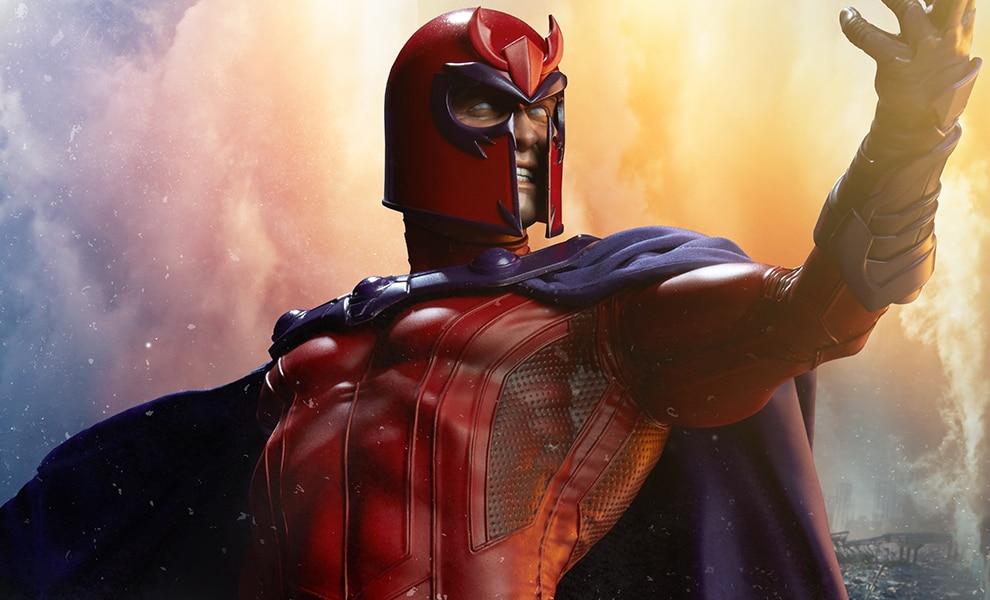
Example #4: Magneto from X-Men
“Villain” — Magneto believes that mutants are superior to humans, and therefore mutants should rule the world. He is willing to achieve this goal at all costs — no matter how many humans are harmed in the process.
“Anti” — Magneto was raised in a German-Jewish family during the Holocaust. This convinced the young and impressionable Magneto that humans are inherently prone to oppress those are different from them. Because he couldn’t protect his family as a child, he becomes obsessed as an adult with protecting the mutant race from living atrocities like genocide.
“The thing none of you will ever understand is that there are no sides. There are no heroes or villains. There’s just what I want and how I’ll get it.”
https://blog.reedsy.com/anti-villain/
Anti-Villains: Heroic Bad Guys
An anti-villain might have heroic goals, but their means of achieving those goals are evil. Alternatively, they might have terrible goals, but will act completely above board and ethically in getting what they want. This does not make them less dangerous to our hero, however.
Generally, anti-villains are aware that they aren’t winning any humanitarian awards with their designated plot, but they are self-aware enough to at least have good PR.
Examples of anti-villains include Inspector Javert from Les Miserables, who truly believes that he’s doing the right thing in pursuing Jean Valjean; he just has a very black-and-white perspective on the criminal psyche. Long John Silver in Robert Louis Stevenson’s Treasure Island also qualifies, since he’s clearly a bad guy (you know, the whole pirate thing), but he’s a bad guy who has his act together, and is fairly sympathetic.
https://thewritepractice.com/anti-villains/
3 Examples of Anti-Villains
Sometimes, the only difference between the “bad guys” and the “good guys” is a point of view.
- Carrie from Stephen King’s book Carrie is a sympathetic anti-villain. As a teenager in a small town, she is an outcast because of her beliefs and the way she dresses. Bullies at school make fun of her incessantly, building to the point where she turns her rage into telekinesis (mind power) to kill everyone in her school, then goes on a killing rampage through the town.
- While The Joker in Batman is fairly straightforward in his villainy, it’s his tragic backstories—at different points, either driven insane by grief after the death of his wife, or disfigured after a fall into a vat of poisonous chemicals—that makes him compelling to watch. The audience suspects that if they were pushed to the edge of their sanity, they might act in the same way—and that’s all it takes to create an anti-villain worth of the caped crusader.
- The character of Draco Malfoy in J.K. Rowling’s Harry Potter series is an example of a troublesome, yet ultimately sympathetic, anti-villain. He is a ruthless, cruel figure throughout much of the books, yet the reader eventually comes to see his behavior as a result of the political and personal choices of his parents. When it comes down to it, he doesn’t kill headmaster Albus Dumbledore as instructed, and struggles with giving his life over to darker forces.
What Is the Difference Between Anti-Villain and Anti-Hero?
While an anti-villain might be a villain with some redeeming features, an anti-hero is a heroic character without the conventional charms. They might do the right thing, but mostly out of self-interest. They are often portrayed as a principled, but somewhat isolated figure, and their heroism is usually a product of their surroundings and circumstances. In some narratives, the anti-hero may be subject to a shift of perspective—like the twist in Gillian Flynn’s Gone Girl that reveals the truth about Amy Dunne’s actions—that paints them as an antagonist.
Other examples of an anti-hero include:
- Tom Ripley of The Talented Mr. Ripley (1955) by Patricia Highsmith
- Huckleberry Finn in The Adventures of Huckleberry Finn (1885) by Mark Twain
- Tony Soprano of The Sopranos (1999)
- Walter White of Breaking Bad (2008)
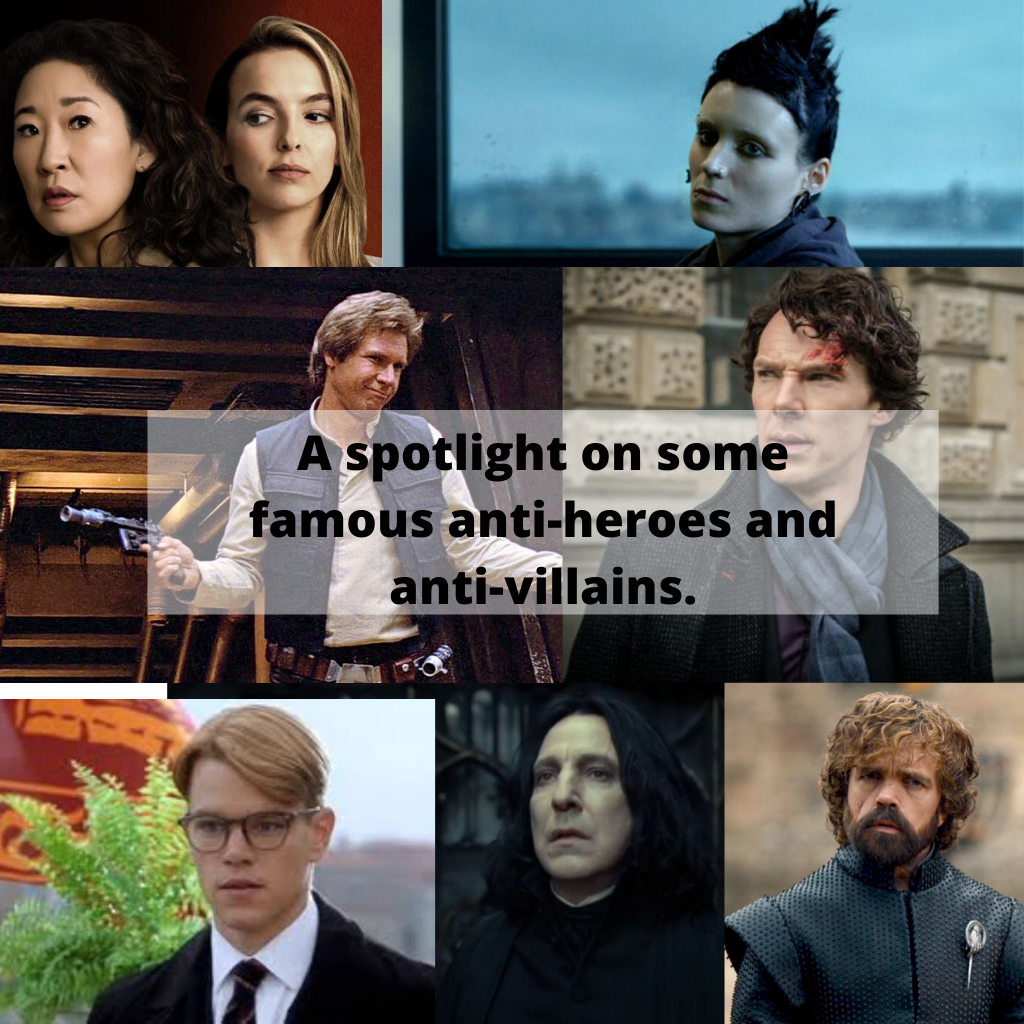
- Lisbeth Salander in The Girl With the Dragon Tattoo (2008) by Stieg Larsson
3 questions to help you define your anti-hero/ anti-villain characters.
Drawing from the Story Grid Editor’s six core questions, here are some questions to ask yourself when considering your anti-hero and anti-villain.
- What do they want? What do they need? Here you must ask: what is the character’s external want or goal? We also want to understand what their inner need might be. Hint: the inner need may well be more opaque, more hidden, so much so that they might not know their inner need even if we can see it
- How do their sense of morality and their inner worldview enable or hinder their external want? Anti-heroes and anti-villains are likely to encounter a moral dilemma that makes them question their role e.g. Tom Ripley questions his decisions and weeps as he kills his love; Eve Polastri wants to capture the assassin but she’s bored with her life and seeking excitement, and has a hidden dark side. Alternatively, they might hold a steadfast moral position that conflicts with the law or societal norms. Jack Reacher and Dexter both hold steadfast moral principles but these principals are at odds with the law. If you’re unsure about the morality genre, read up on the secrets of the morality genre.
- How does the character behave in the showdown? What conflict does it reveal? In an action and thriller story, our characters will face a ‘hero at the mercy of the villain’ scene. This is the ‘showdown’, the core event. Your characters have a chance to show us their conflicted nature. Reacher’s steadfast moral stance and unambiguous worldview allows him to kill villains with no hesitancy. Eve Polastri is confused by her inner conflict and ends up stabbing the villain then regretting it immediately.
One of the best ways to find inspiration for your character and to reflect on the true nature of the anti-hero and anti-villain is to study characters in some masterworks. With that in mind, we’ll now answer these three questions for some famous anti-hero and anti-villain characters.
Raskolnikov – Crime and Punishment
- What does the character want? And what do they really need? Raskolnikov wants to save his sister from poverty and possible prostitution and murders an unscrupulous pawnbroker for her money. He wants to get away with the murder. He needs redemption – self-transcendence – to save himself.
- How do their sense of morality and their inner worldview enable or hinder their external want? Raskolnikov, despite his attempt to justify the murder, has a strong moral compass. This leads to him spiraling into a dark place, and his inner worldview has taken a downturn from a positive value to a negative value.
- How does the character behave in the showdown? What conflict does it reveal? In the showdown of the book – the core event – Raskolnikov confesses to the murder. This is the classic ‘exposure of the criminal’ combined with ‘sacrifice of self’ for self-transcendence. He could have chosen to not confess. This makes Raskolnikov an intriguing anti-villain or anti-hero depending on your interpretation.
Villanelle – Killing Eve
- What does her character want? And what do they really need? She wants to do a good job – to be respected in her profession (as an assassin). What she needs is validation and love.
- How do their sense of morality and their inner worldview enable or hinder their external want? She appears to be wholly immoral. She doesn’t spare anyone when tasked with a job. However, her worldview, that of disillusionment is rattled when she meets Eve, she’s attracted to Eve, and has finally found a glimpse of meaning in her life. This gets in the way of her completing her role for the Twelve (her bosses). Her dry sense of humor reflects her childlike worldview which is one of her many charms.
- How does the character behave in the showdown? What conflict does it reveal? In the final showdown, Villanelle finds Eve in her apartment, and rather than attack and preserve herself as the villain, she lets her guard down, is romantic with and is stabbed. Villanelle is an unusual breed of anti-villain as we empathize with her, despite her terrible deeds.
Lisbeth Salander – The Girl with the Dragon Tattoo
- What does she want? And what does she really need? Lisabeth Salander is a hacker and a private investigator. She wants to help Blomkvist solve the case of the missing girl and the unidentified murdered women. What she needs is acceptance from society and to be loved, but this won’t happen immediately for her and until justice has been served in subsequent books
- How do their sense of morality and their inner worldview enable or hinder their external want? She has her own brand of morality, which is that she will do whatever it takes to take down anyone who she sees as a threat to her. This allows her to solve the case with Blomkvist. However, her worldview is at disillusionment which means that she is distrusting and antagonistic towards most people, which can get in the way of her sleuthing. Finally, what makes her a perfect anti-hero for this role is that she is not the 6 foot 6 inch Jack Reacher bringing her brand of morality and justice to bad people, she is small, smart woman.
- How does the character behave in the showdown? What conflict does it reveal? In the showdown ‘hero at the mercy of the villain’ scene in the first book in the series, Salander finds Blomkvist as he is about to be murdered by Martin Vanger. She attacks him to save Blomkvist then goes after him when he runs away, which leads to him having a car accident.
Tom Ripley – The Talented Mr Ripley
- What does he want? And what does he really need? Tom wants Dickie to love him, and he wants the lifestyle that Dickie has allowed him to have. It’s unclear what he needs – he needs his sexuality to be accepted but his need for Status seems to be more important. He needs happiness.
- How do their sense of morality and their inner worldview enable or hinder their external want? While Tom’s first act of murder was heated, his subsequent killings are more calculated. His ability to kill doesn’t help him get the love he needs, but it does fulfill his desire for wealth. This adds to his grayness – not a villain for the sake of being bad, but one with real regrets.
- How does he behave in the showdown? What conflict does it reveal? The core event/ the showdown in a crime story is the exposure of the criminal. Tom Ripley is in love but he fears that his lover Peter will find out the truth about the ‘secrets in his basement’ – and he kills him to make sure he isn’t revealed. Tom Ripley is a villain but he sobs as he kills his love, and realizes that he is doomed to be alone (he moves from worldview disillusionment). While we know his killings are wrong, we empathize with his inner suffering.
Jack Reacher
- What does he want? And what does he really need? Within each book, Jack wants to save the victim and see justice served. He needs to uphold the values his mother taught him. He doesn’t need external validation or anything else. Across all series, he wants to travel America as a free man, unhindered and unburdened.
- How do their sense of morality and their inner worldview enable or hinder their external want? Reacher would much rather ignore the crime he sees around him as he travels through the towns and cities of America but his strong sense of morality forces him to stop and take action. His simple and minimalist approach to living means that he can travel under the radar – he owns very little: a toothbrush, an ID, and the clothes on his back. His Reacher brand of morality means that he is ok stealing money from villains and using violence to save the victim, quickly.
- How does the character behave in the showdown? What conflict does it reveal? In each story, Reacher finds himself at the mercy of a villain. For Reacher we see him weigh-up the moral dilemma of how much damage he needs to cause to fulfill his obligations to protect those that are vulnerable. Despite being a former MP in the army, he doesn’t abide by the law – he does what he needs to do (breaks wrists, kills) to dispose of the enemy as quickly and efficiently as possible. He’s an anti-hero that we wish we had on our side. Our emotions are more than empathy, we admire him.
Jack Sparrow – Pirates of the Caribbean
- What does he want? And what does he really need? Jack Sparrow serves his own needs, it just so happens that his own needs often correspond with the heroes of the story.
- How do their sense of morality and their inner worldview enable or hinder their external want? Sparrow is pretty unscrupulous. He thinks mostly for himself, and as a result, he finds himself in bad situations and no one trusts him.
- How does the character behave in the showdown? What conflict does it reveal? Ultimately, in the showdown, Sparrow finds himself on the side of the heroes by accident and helps them to triumph, the hero Will helps him to escape as a reward, and in the end, Sparrow returns to his pirate ways. (in the first movie, Curse of the Black Pearl).
Hans Solo – Star Wars
- What does he want? And what does he really need? Solo begins the story as a scoundrel only caring about himself and his crew, what he needs is a purpose, a real reason to fight for something.
- How do their sense of morality and their inner worldview enable or hinder their external want? Solo’s worldview is upset when he connects with Luke and Leia and his character arc changes from a selfish object of desire to one of helping the rebellion and his new friends.
- How does the character behave in the showdown? What conflict does it reveal? In the showdown, when Luke is attacking the Death Star, Solo surprisingly returns to help Luke, wounding Darth Vader’s ship and allowing Luke to destroy the Death Star and showing his completed character arc.
Tyrion Lannister – Game of Thrones
- What does your character want? And what do they really need? Tyrion wants to survive and he needs to have a purpose.
- How do their sense of morality and their inner worldview enable or hinder their external want? His need to survive continually draws him back to support his family, who treat him very badly. But once they imprison him and threaten his execution, he is freed from their influence and his sense of purpose draws him to work for the dragon queen.
- How does the character behave in the showdown? What conflict does it reveal? The showdown is the final battle between his family and the dragon queen. His need to find purpose aligns him with choosing what he thinks is a more just, better leader (in the dragon queen) over his own family.
Severus Snape – Harry Potter Series
- What does he want? And what does he really need? Snape wants to support Voldemort and the Death Eaters, that is his nature, but he needs revenge on Voldemort for killing Lilly Potter.
- How do their sense of morality and their inner worldview enable or hinder their external want? He is torn throughout the series of books, but his loyalty to Lilly Potter wins out.
- How does the character behave in the showdown? What conflict does it reveal? His affinity to the Death Eaters allows him to get close enough to Voldemort to betray him.
Sherlock Holmes
- What does your character want? And what do they really need? Sherlock Holmes is bored, his want and need is not to be bored.
- How do their sense of morality and their inner worldview enable or hinder their external want? He solves cases for the police because they intrigue him, not because he has any wish to see justice done. If he just solved the cases because he wants to help the victims then he would be a good but ordinary detective, instead he is an intriguing anti-hero. We remain fascinated by him.
- How does the character behave in the showdown? What conflict does it reveal? In the books and the movies, the showdown is always when Sherlock Holmes outwits the villain, but Holmes does not change from winning the case nor does he really care how the outcome affects the villain or the victims, he just moves on to the next case.
It’s time to create your compelling character.
Once you’ve addressed the three questions raised in this article for your character, consider their role across the three acts and how their character needs to behave and change across the whole story. Write out your character’s story arc against the three-part act and compare it to the character arc for your favourite anti-hero or anti-villain. Consider how your character’s complex nature shows up in the all-important Core Event.
https://storygrid.com/create-your-anti-hero-or-anti-villain/

 KC Storytellers